Ask a small brand about its email marketing and you usually hear about the newsletter. The monthly update, the sale announcement, the new collection. Those campaigns matter, but they are not where most of the money comes from.
The quiet earners are flows: automated emails that send themselves when a customer does something. Someone joins the list, leaves a cart, buys for the first time, stops buying. Each of those moments has a best next message, and email marketing automation makes sure it arrives on time, every time, without anyone pressing send.
A campaign goes to everyone at a time you choose. A flow goes to one person at the moment their behaviour says they are ready. That difference shows up clearly in the data.
Klaviyo’s benchmark data also shows revenue per recipient for flows at nearly 18 times that of campaigns. For a small team, that makes flows the highest-return email work you can do: build them once, improve them monthly, and let them run.
The 5 email marketing automation flows to build first
1. Welcome flow
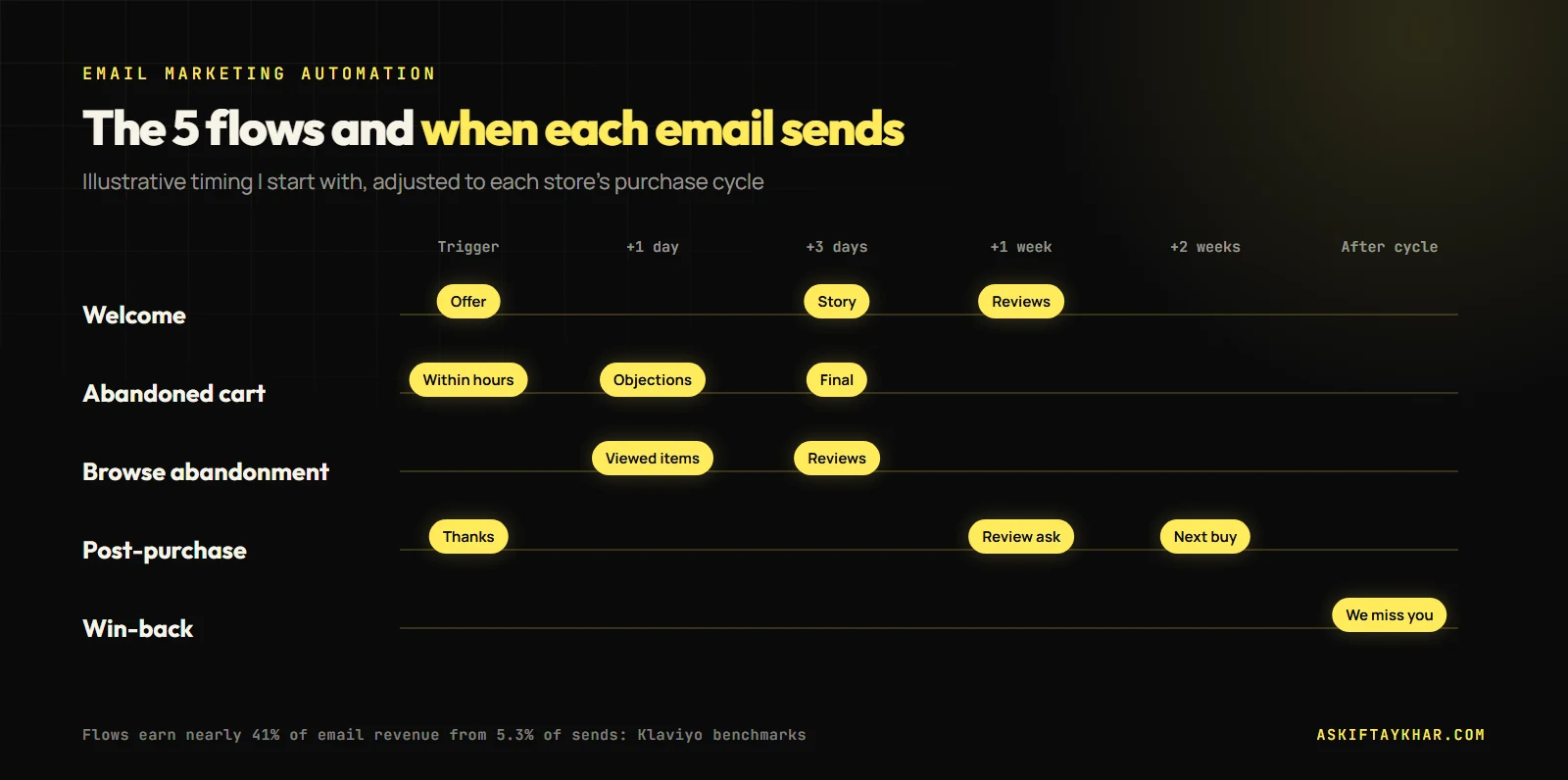
Triggered when someone subscribes. This is the moment attention is highest, so it is where you introduce the brand, deliver whatever you promised for signing up, and give a first reason to buy.
I usually build three emails over about a week: the promised offer or content immediately, the brand story and best sellers a couple of days later, and social proof such as reviews near the end. Anyone who buys leaves the flow straight away.
2. Abandoned cart flow
Triggered when a known subscriber adds to cart and does not check out. With roughly 70% of carts abandoned on average, this is the flow that pays for everything else.
My default timing is a reminder within a few hours, a second email the next day that answers common objections (delivery times, returns, sizing), and a final one after two to three days. I only add a discount on the final email, and only if margins allow, because training customers to abandon carts for a code is a real risk.
3. Browse abandonment flow
Triggered when a known visitor views products but does not add to cart. It is softer than the cart flow: one or two emails showing what they looked at, with related items and reviews. No hard sell.
4. Post-purchase flow
Triggered by a first order. Most brands send a receipt and disappear. A good post-purchase flow thanks the customer, sets expectations for delivery, shows how to get the most out of the product, asks for a review once it has arrived, and then suggests the natural next purchase. This is where one-time buyers become repeat buyers.
5. Win-back flow
Triggered when a customer has not bought for longer than your normal repurchase cycle. For a fashion label that might be around 90 days; for a consumable it might be much shorter. The flow reminds, shows what is new, and makes a final offer before the contact is moved to a lower-frequency segment.
What goes inside a flow email
Flow emails work best when they read like a helpful note from a person, not a flyer. For most small brands I follow the same simple structure, and it keeps writing fast.
- A subject line that names the moment. “Still thinking about the linen shirt?” beats “Don’t miss out!” because it is specific to what the customer did.
- One idea per email. A reminder, an answer to an objection, a review, a suggestion. Never all four.
- The product or content they engaged with, shown clearly. Dynamic blocks in most email platforms pull the exact item from the cart or browsing history.
- One main button. Back to cart, see the collection, leave a review. A second link can sit lower down, but the main action should be obvious.
- Proof close to the button. A short review, a delivery promise or a returns policy often does more than a discount.
I also keep flows short on purpose. It is tempting to add a fifth and sixth email to every sequence, but each extra email raises the chance of an unsubscribe or a spam complaint, and complaints damage the whole sending domain, not just the flow.
Stop judging flows by open rate
Since Apple introduced Mail Privacy Protection in 2021, Apple Mail can load email content privately in the background, which registers as an open whether or not a person actually read the email. Open rates have become inflated and unreliable as a result.
I judge flows on click rate, placed order rate and revenue per recipient. Those numbers come from real actions. If a flow’s revenue per recipient drops, something in it needs fixing; if its open rate rises, that may mean nothing at all.
Connecting flows to the rest of your marketing
Flows are strongest when they work with paid social rather than separately. The same customer who ignores a win-back email may respond to a retargeting ad a day later. For Icon Shopper, a fashion label, the growth plan centred on repeat purchases rather than chasing one-time buyers, with retention retargeting on Meta and seasonal offer cycles. Email flows and retention ads chase the same goal from two directions.
At Remotie, email marketing was one of five backend channels I ran together with social media, Google Ads, AI automations and business development. Running them under one owner makes it much easier to keep the messages consistent across channels.
How I map a flow before writing a single email
- Pull the purchase data and find the typical time between first and second order.
- Set the win-back trigger just after that point, and the post-purchase cross-sell before it.
- Write the goal of each email in one sentence before writing the email.
- Add exit conditions: anyone who buys leaves a sales flow immediately.
- Review every flow monthly on clicks, orders and revenue per recipient.
What you need before you start
You do not need a huge list. You need three things: an email platform that can trigger on store events (Klaviyo, Omnisend, Mailchimp and most modern tools can), your store connected so it knows about carts and orders, and a sending domain that is properly authenticated so the emails land in the inbox. That last part is more technical than it sounds, and I explain it in why emails land in spam.
Flows are a big part of my email marketing service, and more complex ones, such as flows that react to CRM data or support tickets, are built with AI task automations. Retargeting that works alongside them sits in Meta marketing. You can read more about me on the About page.
 Iftaykhar MahmudGrowth marketer, Dhaka