The Meta Ads Learning Phase: The Budget Math That Gets You Out of Learning Limited
Most ad sets stuck in "Learning limited" are not badly targeted. They are underfunded for the result they chase. Here is the simple budget math and the account structure that fixes it.
The Meta ads learning phase is the period after launch or a significant edit when Meta is still working out who to show your ad to. Ad sets usually exit it after about 50 results in a week, so your daily budget needs to be roughly your cost per result multiplied by 50, divided by 7.
Key takeaways
Meta says ad sets usually leave the learning phase after about 50 results in the week after the last significant edit.
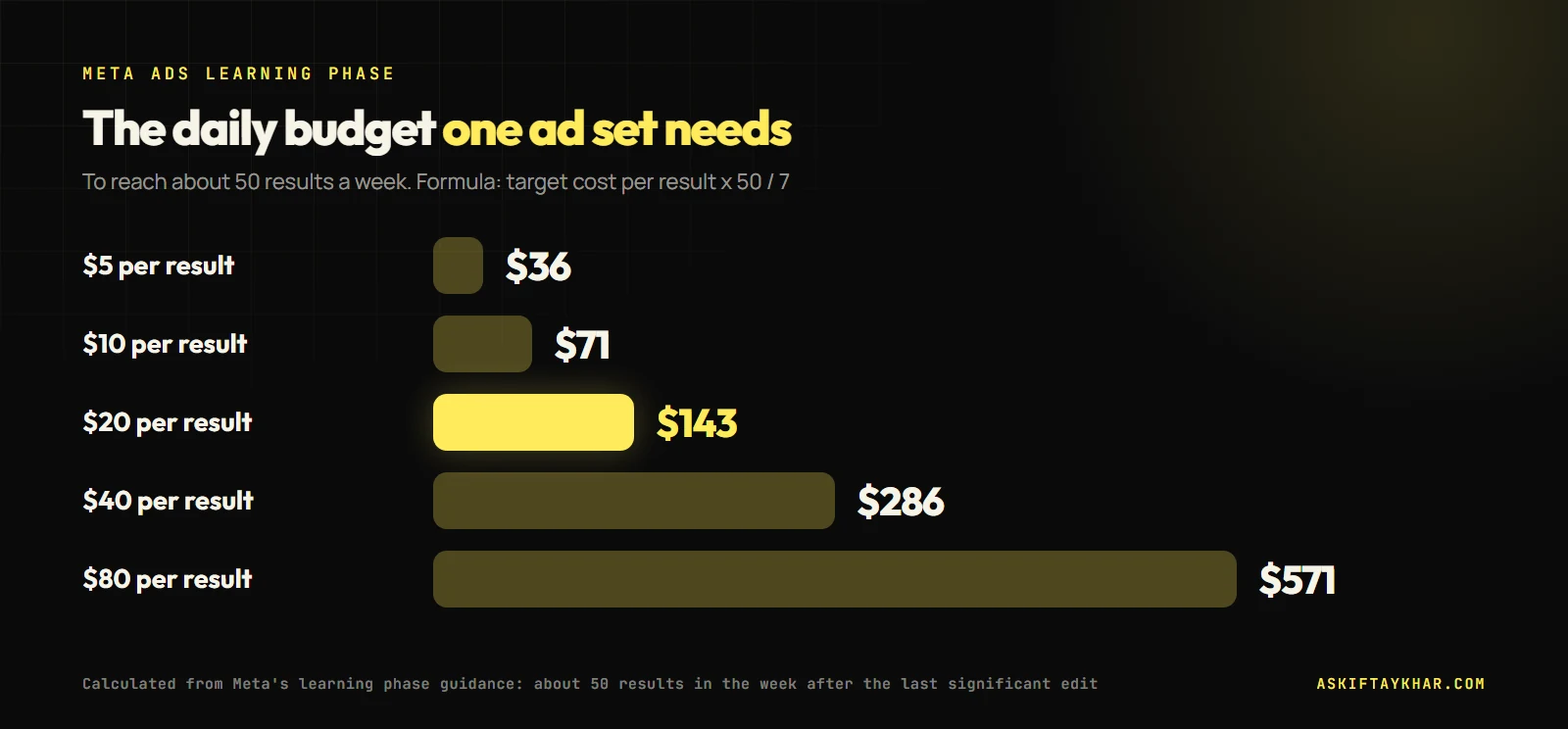
Daily budget needed is roughly target cost per result x 50 / 7. At a $20 cost per result that is about $143 a day for one ad set.
If the math does not work, consolidate ad sets or optimise for a more frequent event instead of splitting budget further.
Budget jumps, new creative and targeting changes can all restart learning, so batch your edits.
Here is a setup that shows up in a lot of small business ad accounts. Five ad sets, each with its own interest audience, each running on $10 a day, each labelled “Learning limited” in the delivery column. The owner has been told to be patient and wait for the algorithm to learn. It never does.
The problem is not the targeting and it is not the creative. It is arithmetic. Once you understand how the Meta ads learning phase actually works, you can look at almost any account and predict within a minute whether it is set up to succeed.
What the Meta ads learning phase is
Every time you launch an ad set, or make what Meta calls a significant edit, the delivery system starts exploring. It tests your ads with different people, placements and times to find out where results come from. That exploration period is the learning phase, and performance during it is less stable and usually more expensive.
According to Meta’s own help documentation, ad sets exit the learning phase once they can deliver stably, which usually happens after about 50 results in the week after the last significant edit. A “result” here means the optimisation event you chose: a purchase, a lead, a completed registration.
If your ad set cannot reach that level, Meta labels it “Learning limited”. That label is not a penalty. It is Meta telling you, politely, that the ad set is not getting enough results to optimise properly.
The budget formula for the Meta ads learning phase
Here is the math I run before launching any ad set.
Daily budget needed = (target cost per result x 50) / 7
If you expect a lead to cost about $20, one ad set needs roughly $143 a day to have a realistic chance of reaching 50 leads in a week. Split that same budget across five ad sets and none of them get there.
Daily budget = target cost per result x 50 / 7. At $20 a result, one ad set needs about $143 a day.
The chart uses nothing but that formula, and it explains why so many small accounts stall. A business spending $50 a day in total can just about exit learning with one ad set if its cost per result is around $7. At a $30 cost per result, the same $50 cannot even fund one ad set properly.
Target cost per result
Results needed per week
Daily budget for one ad set
$5
50
about $36
$10
50
about $71
$20
50
about $143
$40
50
about $286
$80
50
about $571
These numbers are not a law of nature. Meta says “about 50”, and plenty of ad sets stabilise a little before or after. But the formula is the fastest honest check I know, and it turns a vague complaint (“Facebook isn’t working”) into a specific decision.
What to do when the math does not work
Most small businesses cannot fund $286 a day per ad set. That is fine. You have four levers, and Meta’s own guidance for learning limited ad sets points at the same ones.
Consolidate before you spend more
Five ad sets at $10 a day compete with each other for the same learning. One ad set at $50 a day learns five times faster. For most local businesses I run one prospecting ad set with a broad audience and one retargeting ad set, and nothing else, until results justify splitting.
Optimise for a more frequent event
If purchases are too rare, optimise for a step that happens more often and still signals intent, such as add to cart, initiated checkout or a completed lead form. You trade some precision for a delivery system that can actually learn. Move back to the deeper event once volume allows.
Broaden the audience
Narrow interest stacks shrink the pool Meta can explore. With Advantage+ audience or broad targeting, the creative does more of the targeting work, which is why I put so much effort into a proper creative testing system.
Make sure every real result is counted
If a share of your real conversions never reaches Meta, you need even more budget to hit 50 reported results. Server-side tracking closes that gap, and I explain it in the Meta Conversions API guide.
Edits that restart the Meta ads learning phase
Meta says edits that meaningfully change how an ad set might perform can send it back into learning, and it specifically warns against frequent budget changes. In practice, these are the edits I batch together rather than making one at a time:
Changing the targeting, placements or optimisation event.
Adding new creative to an ad set, or pausing the best performer.
Large budget changes. I raise budgets in steps of about 20% every few days rather than doubling overnight.
Pausing an ad set for a week or more.
A good rule: make your changes once a week, together, and then leave the ad set alone long enough to judge it. Daily tinkering is one of the easiest ways to keep a campaign permanently in learning.
A local business example
Food and repair businesses make the learning phase feel harder than it is, because their audience lives inside a small radius. When I built appetite-first creative and delivery-zone targeting for Healthy Eats, the audience was never going to be huge. Small local audiences are exactly where a lean structure matters most: few ad sets, creative doing the heavy lifting, and patience between edits.
The rebuild for OZ Mobile Phone Repair followed the same logic: a clear audience architecture with exclusions and lookalikes, plus always-on retargeting to warm local audiences.
My starting structure for a small budget
One campaign with Advantage campaign budget or a single ad set budget.
One broad prospecting ad set with three to five distinct creative concepts.
One retargeting ad set for site visitors and engagers from the last 30 days.
One optimisation event that the budget can realistically deliver 50 times a week.
A weekly review day for all edits, with results compared against the booking or sales system.
A worked example with a $60 daily budget
Say a home cleaning company spends $60 a day and its website leads cost about $25 each. Run the formula and one ad set needs (25 x 50) / 7, roughly $179 a day. At $60 a day the account produces about 17 leads a week, a third of what Meta wants. Splitting that across three audiences would leave each ad set with five or six leads a week, which is not enough for anything to learn.
Here is the order I would work through:
Check the tracking. If Meta only sees part of the real leads, the reported number is even lower than the true one. Fix that first, because it is free.
Collapse to one ad set. One broad audience, three to five creative concepts, the full $60 behind it.
Look for a more frequent event that still means something. A completed form is more frequent than a booked quote visit. Optimising for the form while sending the booked visits back as a separate event keeps the signal honest.
Accept learning limited if needed, and judge on the business number. If 17 leads a week at $25 is profitable, the label in Ads Manager matters far less than the invoices.
The point of the formula is not to make every small account look hopeless. It is to stop owners paying for five experiments that can never finish.
When learning limited is acceptable
Sometimes the honest answer is that your market is small and your product is expensive. A high-value B2B service might get ten qualified leads a week at best. In that case, learning limited is simply the state of the account, and the job becomes feeding Meta the best possible signal: qualified leads rather than raw form fills, sent back through the Conversions API, with realistic expectations about stability.
If you want a second pair of eyes on your structure, this is exactly the kind of fix that sits inside my Meta marketing service. You can also read about my background on the About page.
There is no fixed number of days. Meta says ad sets usually exit learning after about 50 results in the week after the last significant edit, so an ad set with enough budget typically stabilises within about a week.
What does Learning limited mean on Meta ads?
It means the ad set is not getting enough results to exit the learning phase. Meta shows the status when an ad set is unlikely to reach about 50 results a week, usually because the budget is too small, the audience too narrow or the optimisation event too rare.
Does increasing the budget reset the learning phase?
Large or frequent budget changes can send an ad set back into learning. Small, spaced increases are safer. I raise budgets in steps of about 20% every few days and avoid changing anything else at the same time.
Should I turn off ads that are still in the learning phase?
Usually not. Costs are often higher and less stable during learning, so judging an ad set in its first days leads to bad decisions. Give it a full week with no edits unless something is clearly broken.
How much should a small business spend on Meta ads per day?
Work backwards from your cost per result. Multiply the cost you expect per lead or sale by 50 and divide by 7. That gives the daily budget one ad set needs to learn properly. If it is more than you can spend, run fewer ad sets or optimise for a more frequent event.
When Ads Manager says a campaign failed but your till says otherwise, the problem is usually tracking, not the ads. Here is how the Meta Conversions API fixes it, step by step.
 Iftaykhar MahmudGrowth marketer, Dhaka