Here is a pattern that costs businesses more than any bad ad. A campaign is working. The phone number is on the page, the form is short, the leads are coming in. Then the enquiries sit. Someone checks the inbox after lunch, replies to the ones that look good, and calls the rest back tomorrow. By then, half of those people have already booked someone else.
Speed to lead, the time between an enquiry and your first response, is one of the most important numbers in any business that pays for leads. It is also one of the easiest to fix.
What the research says about speed to lead
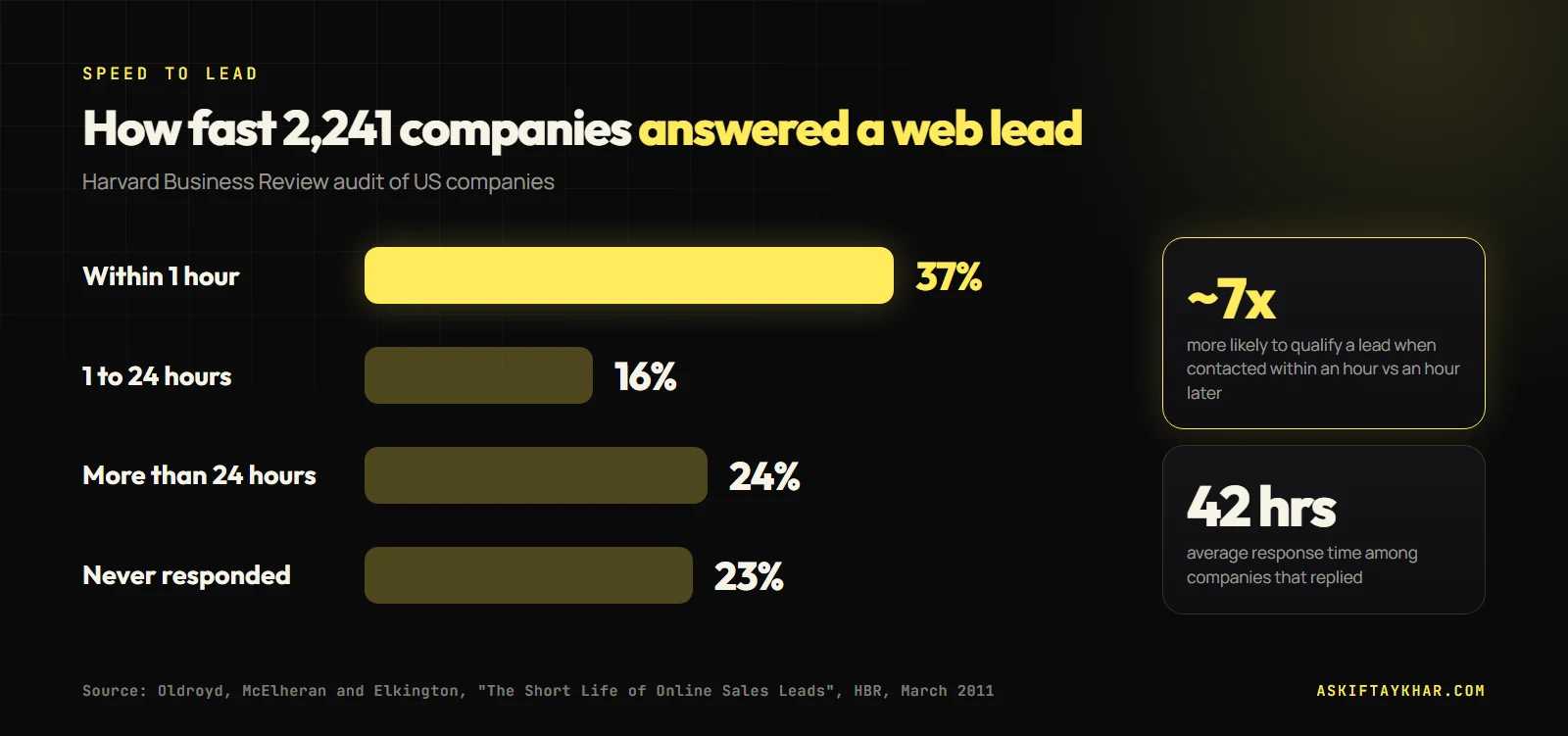
The best-known study on this was published in Harvard Business Review in 2011. The researchers audited 2,241 US companies by sending a web enquiry and measuring how long each took to respond.
The results were striking. Only 37% responded within an hour. 16% took between one and 24 hours, 24% took more than a day, and 23% never responded at all. Among the companies that did reply within 30 days, the average response time was 42 hours.
The researchers also looked at what speed was worth. Firms that tried to contact a lead within an hour were nearly seven times as likely to qualify that lead as firms that tried even an hour later, and more than 60 times as likely as firms that waited 24 hours or longer. Qualifying, in the study, meant having a meaningful conversation with a decision maker.
The study is more than a decade old, but the behaviour behind it has not changed. If anything, it is easier than ever for a customer to fill in three forms in ten minutes and go with whoever answers first.
Why slow follow-up is so expensive
Think about what a paid lead costs. You paid for the click, the landing page, the ad creative and the time to set it all up. If a lead from Google Ads costs you $40 and a slow response halves the chance of it becoming a customer, you have effectively doubled your cost per customer without touching the ads.
That is why I treat lead response as part of the advertising system, not a separate admin task. The best Google Ads management in the world cannot fix a lead that nobody answers.
The AI follow-up system I build
The goal is simple: every lead gets a relevant, personal response within a minute, and a person picks up the conversation as fast as the business can manage. Here is the structure.
1. Capture every lead in one place
Forms, ad lead forms, WhatsApp, Instagram and Facebook messages, and missed calls all feed one list with the source recorded. Leads that arrive in five inboxes get answered at five different speeds.
2. Instant, personal acknowledgement
Within a minute, the person gets a reply by the channel they used, written for their actual enquiry. AI reads the enquiry and adapts a template: “Thanks, Sarah. A cracked screen on an iPhone 13 is usually a same-day job. Are you able to bring it in today?” That reads nothing like “Thank you for your enquiry. We will be in touch.”
3. Qualify with two or three questions
The AI asks the questions a good receptionist would: what exactly is needed, where they are, how soon. Answers are saved to the lead record so the human does not ask again.
If the lead is ready, it gets a booking link or available time slots straight away. Many people will book on the spot if the option is in front of them.
5. Hand over to a person with a deadline
Every lead that needs a human is assigned with a target response time, and the team gets an alert. If nobody responds within that window, the alert escalates.
6. Follow up automatically if they go quiet
People get busy. A short, friendly sequence checks in over the next few days and stops the moment they reply or book.
What a good first reply says
Fast is not enough if the reply is empty. The first message should do four things, in a few short lines:
- Use their name and their words. Repeat the actual problem they described, so they know a person or a well-briefed system read it.
- Set an expectation. “Most screen repairs take about an hour” or “We usually quote within one working day” answers the question they have not asked yet.
- Ask one useful question. Not five. The single answer you need to move forward.
- Offer the next step. A booking link, two time slots, or a direct phone number for urgent cases.
I write these templates with the client, in the tone they would use on the phone, and let AI fill in the details from each enquiry. The result sounds like the business, just faster.
Speed to lead after hours
Plenty of enquiries arrive in the evening and at weekends, when people finally have time to deal with a broken phone or a quote they have been putting off. An automated system does not sleep. It acknowledges, qualifies and books overnight, and the team starts the morning with a sorted list and some appointments already in the calendar.
What it looks like in practice
For Asorin Management Inc., a mobile car key business in the Greater Toronto Area, the core problem was enquiries scattered across phone, email and messages. The work turned them into one booked, trackable pipeline, which maps onto steps 1, 4 and 5 above, in a business where a customer locked out of their car will not wait long.
At Remotie, follow-up moved from manual to automated with AI task workflows as part of the backend growth engine I ran for the agency.
The response time targets I set with clients
- Automated acknowledgement: under one minute, every lead, every hour of the day.
- Human response during business hours: inside the hour, ideally within 15 minutes for urgent services.
- After-hours leads: acknowledged instantly, called back first thing the next morning.
- Every lead tracked with its first response time, reviewed weekly.
Measure your own speed to lead this week
You do not need software to find out where you stand. Submit an enquiry on your own website from a personal email, on a weekday afternoon and again on a Saturday. Time how long each takes to get a reply, and read the reply as a customer would. Most owners are surprised.
Then work backwards from the answer. If the gap is hours, an instant acknowledgement and an alert system will recover more revenue than any new campaign. For the wider picture of what to automate, see 7 AI automation workflows worth building first, and make sure the leads you are chasing are being counted properly with the Google Ads conversion tracking checklist.
Designing and running follow-up systems is a core part of my AI task automations and AI lead generation work. You can read more about me on the About page.
 Iftaykhar MahmudGrowth marketer, Dhaka