A B2B Lead Scoring Model You Can Run in a Spreadsheet (Then Automate)
Small B2B teams do not need a complex scoring engine. They need a clear way to decide which leads get a call today. Here is a two-part scoring model you can run in a spreadsheet this week.
B2B lead scoring gives each lead points for how well the company fits your ideal customer (fit) and how interested it seems right now (intent), then uses the total to decide who gets contacted first. A small team can run it in a spreadsheet with ten or so rules, and automate it once the thresholds prove themselves.
Key takeaways
Score two things separately: fit (who they are) and intent (what they are doing now).
Keep the model small: around ten rules is enough to start.
Set clear thresholds that trigger an action, such as a call within the hour for hot leads.
Let intent points fade over time and recalibrate the model every quarter against closed deals.
Every growing B2B team hits the same wall. At first, every lead gets a personal call because there are only a few. Then marketing starts working, leads arrive every day, and the team starts choosing by gut feel. The loudest lead gets attention. The best one sometimes waits a week.
B2B lead scoring replaces gut feel with a simple rule set: points for fit, points for intent, and a threshold that tells the team what to do next. You do not need expensive software to start. You need a spreadsheet and an honest look at your past deals.
Why a small team needs lead scoring
Two numbers make the case. Gartner reports that B2B buyers spend only about 17% of their buying time meeting potential suppliers, so the window to be part of the conversation is small. And the Harvard Business Review study on lead response found that firms contacting leads within an hour were nearly seven times as likely to qualify them as firms that waited longer.
Put together: the leads most likely to buy need the fastest response, and a scoring model is how you know which ones those are.
The two parts of a lead scoring model
Fit: who they are
Fit measures how closely a lead matches your ideal customer profile. It barely changes over time. Industry, company size, location, job title of the contact and budget signals all belong here. If you have not written your ideal customer profile yet, start with building an ICP-first prospect list.
Intent: what they are doing now
Intent measures current interest. It changes constantly. Requesting a quote, visiting the pricing page, replying to an email, attending a webinar, or opening a proposal all belong here.
Keeping the two separate matters. A perfect-fit company with no current intent needs nurturing, not a sales call. A poor-fit company with high intent might need a polite referral elsewhere. Adding both into one number hides that difference, so I track both and use the total for priority.
A starting B2B lead scoring model
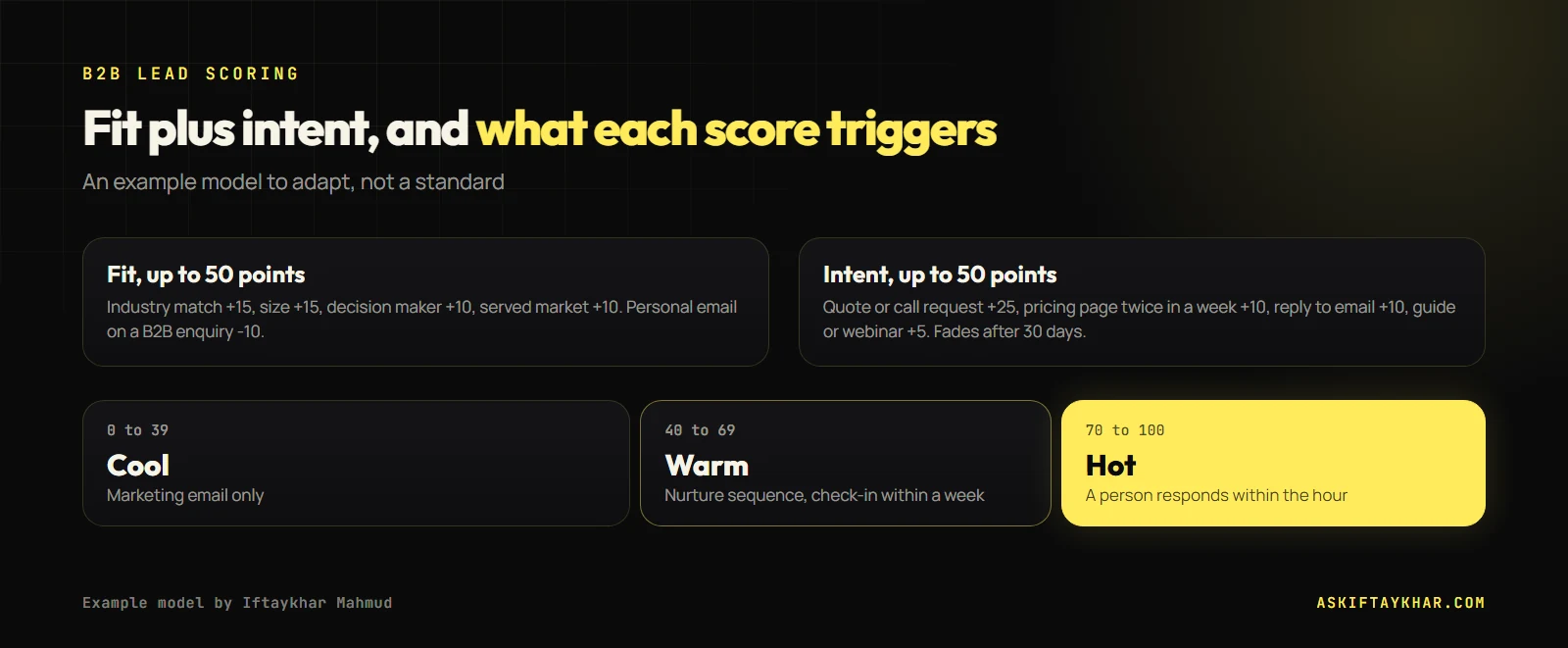
This is an example model for a B2B service business. The point values are a starting point to adjust, not a standard. Fit and intent are each capped at 50, for a total out of 100.
An example model: 50 points for fit, 50 for intent, and a clear action for each band.
Signal
Type
Points
Industry matches your ICP
Fit
+15
Company size in your target range
Fit
+15
Contact is a decision maker or budget holder
Fit
+10
Located in a market you serve well
Fit
+10
Requested a quote or a call
Intent
+25
Visited the pricing or services page twice in a week
Intent
+10
Replied to an outreach or nurture email
Intent
+10
Downloaded a guide or attended a webinar
Intent
+5
Personal email domain on a B2B enquiry
Fit
-10
Student, job seeker or supplier enquiry
Fit
-30
Thresholds that trigger action
A score is useless unless it tells someone what to do.
70 and above, hot: a person calls or replies personally within the hour.
40 to 69, warm: added to a relevant nurture sequence, with a personal check-in within a week.
Below 40, cool: stays in marketing email only; no sales time spent.
Let intent fade
Interest from two months ago is not interest today. I let intent points expire after about 30 days unless the lead does something new. Fit points stay. That way the hot list always reflects who is active right now.
Run it in a spreadsheet first
Before automating anything, run the model by hand for a few weeks. Put every new lead in a sheet with a column per signal, a formula for the fit total, the intent total and the combined score, and a column for what happened: meeting, proposal, won, lost.
After a month, look at the leads that became customers. Did they score high? If good customers keep scoring 45, your thresholds are wrong. If a signal never appears among winners, drop it. A lead scoring model is a hypothesis about your buyers, and the spreadsheet is where you test it cheaply.
Then automate it
Once the model holds up, move it into your CRM or connect it with an automation tool. Fit can be scored automatically from form fields and enrichment data. Intent can be scored from website visits, email replies and form submissions. AI helps with the messy parts: reading a free-text enquiry and deciding whether it is a real buyer, a job seeker or a supplier pitch.
The automated version should also act on the thresholds: alert the right person for hot leads, enrol warm leads in the right sequence, and log everything. That is where scoring connects to a fast AI follow-up system.
Common lead scoring mistakes
Scoring activity instead of intent. Ten email opens do not equal one quote request. Weight actions by how close they are to buying.
Never subtracting points. Without negative rules, job seekers, students and suppliers pitching you end up on the hot list.
Letting marketing and sales use different definitions. If marketing calls a lead “qualified” at 40 and sales only calls at 70, both teams feel let down. Agree the thresholds together.
Setting it and forgetting it. Your market, offer and channels change. A model built on last year’s deals slowly drifts out of date.
Hiding the reasons. A score of 72 is more useful when the salesperson can see why: right industry, decision maker, asked for a quote yesterday. Show the signals, not just the number.
How it fits real business development
At Remotie, business development was one of five backend channels I ran, alongside email, social media, Google Ads and AI automations. When several channels feed one pipeline, a shared way of ranking leads is what stops the team treating every source differently.
For Mascot Knits Limited, a garment manufacturer prospecting international buyers, fit mattered enormously: a buyer’s product categories, order sizes and compliance needs decide whether a conversation is worth having at all.
How I build a scoring model with a client
Pull the last 20 to 50 closed deals, won and lost.
List what the won deals had in common before they bought.
Turn those traits into five fit rules and five intent rules.
Run the model by hand in a spreadsheet for a month.
Adjust thresholds against real outcomes, then automate.
Review every quarter against the latest closed deals.
B2B lead scoring assigns points to each lead based on how well the company fits your ideal customer and how interested it seems right now. The total decides who gets contacted first and how.
What is the difference between fit and intent in lead scoring?
Fit is who the lead is: industry, size, role and location. It rarely changes. Intent is what the lead is doing: requesting quotes, visiting key pages, replying to emails. It changes constantly and should fade over time.
How many rules should a lead scoring model have?
Around ten is enough to start: roughly five for fit and five for intent, including a couple of negative rules. More rules make the model harder to understand without making it more accurate.
Do I need a CRM for lead scoring?
Not to start. A spreadsheet is the best place to test a scoring model because you can see every rule and adjust it quickly. Move it into a CRM or automation tool once it reliably predicts which leads become customers.
How often should I update my lead scoring model?
Review it every quarter against recent won and lost deals, and adjust point values and thresholds when high-scoring leads stop converting or good customers keep scoring low.
AI makes it easy to build a list of 10,000 prospects and email all of them. That is exactly how domains get burned. Here is the ICP-first process I use to build smaller lists that reply.
 Iftaykhar MahmudGrowth marketer, Dhaka