Skip to content

The Cold Email Sequence That Books Meetings: Structure, Timing and Follow-Ups

Most cold emails fail before anyone reads them, and most of the rest fail in the first line. Here is the four-email sequence I use, with timing, examples and the infrastructure that keeps it out of spam.

Cold email sequence guide cover: four emails over two weeks that book meetings, by Iftaykhar Mahmud
On this page
  1. Before the sequence: the plumbing
  2. The four-email cold email sequence
  3. Subject lines for a B2B cold email
  4. Cold email follow-up rules I never break
  5. Is cold email legal?
  6. What makes the sequence work: the list
  7. Where this came from in real work

Short answer

A cold email sequence that books meetings is short and relevant: usually four plain-text emails over about two weeks, each with one clear idea and a low-effort ask. It is sent from a separate, authenticated domain in small daily volumes to a researched list, and it stops the moment someone replies or opts out.

Key takeaways

  • Four emails over roughly two weeks: the opener, a proof bump, a useful insight and a polite close.
  • Keep the first email short, plain text and focused on the prospect's situation, not your company.
  • Ask for interest, not a calendar slot, in the first email.
  • Send from a separate authenticated domain and keep spam complaints well below Gmail's 0.3% limit.
Think about the last cold email you actually replied to. It was probably short. It mentioned something specific about your business. It asked a question you could answer in one line. And it did not arrive as part of a blast of identical messages from a brand-new domain.

That is the whole craft of a cold email sequence in one paragraph. The rest is structure, timing and the plumbing that gets the email into the inbox in the first place. Here is the sequence I use and why each part is there.

Before the sequence: the plumbing

A great cold email in the spam folder books nothing. Before writing a word, I set up:

  • A separate sending domain, so complaints never touch the domain used for customers and invoices.
  • SPF, DKIM and DMARC on that domain, aligned properly. Gmail and Outlook both enforce authentication for high-volume senders, and inbox providers look for it on everyone.
  • A warm-up period of gradually increasing volume before any campaign.
  • Modest daily volume per inbox, spread across a few inboxes rather than one pushing hundreds.
  • A verified list, so bounces do not damage reputation.

Gmail asks senders to keep their spam rate below 0.1% and never reach 0.3%. With cold email, that margin disappears quickly if the list or the message is wrong. The full setup is explained in why emails land in spam.

The four-email cold email sequence

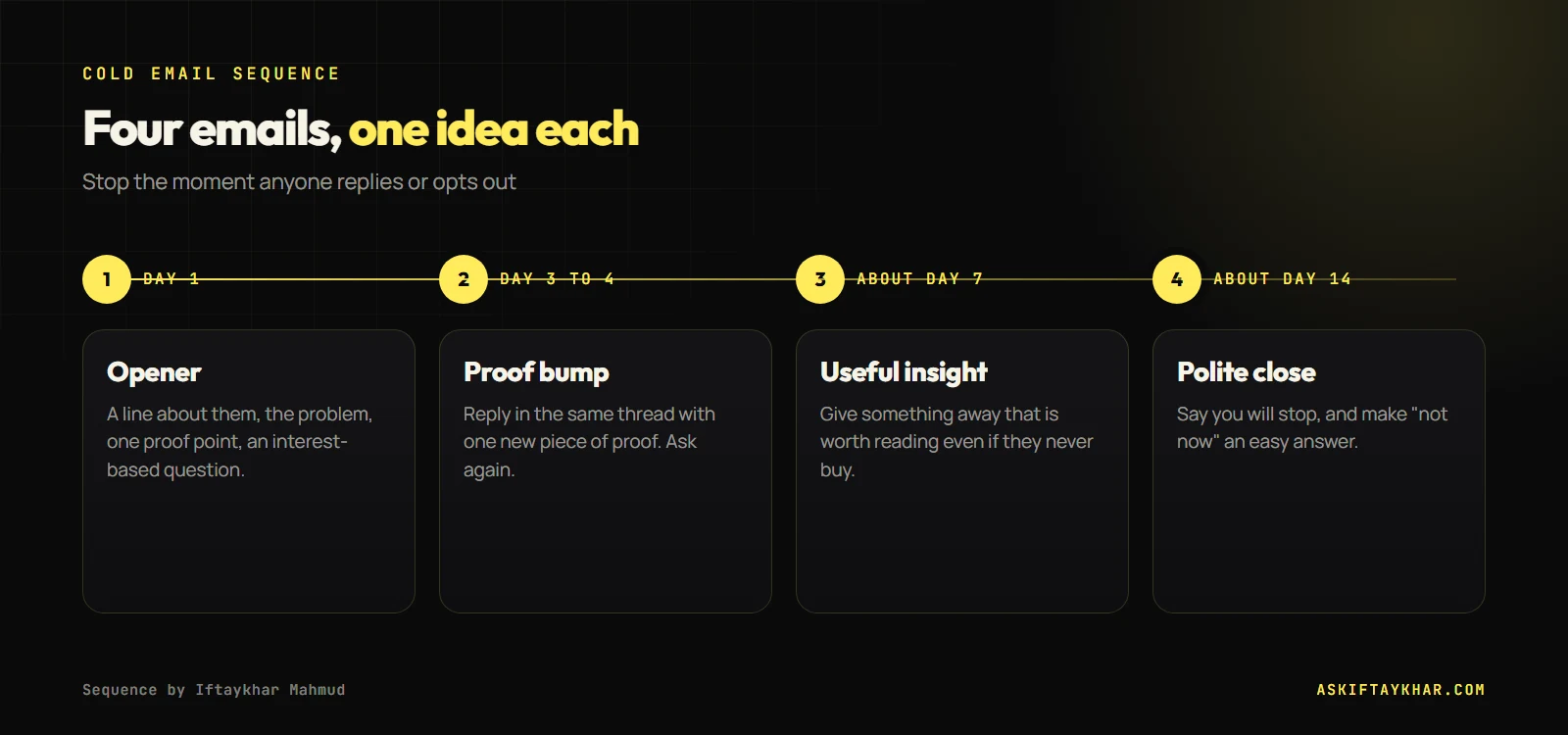
Cold email sequence timeline with four emails: opener on day 1, proof bump on day 3, useful insight around day 7 and polite close around day 14
Four short emails, one idea each. The sequence stops the moment someone replies.

Email 1 (day 1): the opener

The first email has one job: earn a reply. It should be short enough to read on a phone without scrolling, in plain text, with no images and ideally no links.

A structure that works:

  1. A first line about them. A real observation from your research, not flattery.
  2. The problem you think they have. One sentence, stated carefully.
  3. One line of proof. Who you have helped with the same problem.
  4. An interest-based question. “Worth a short chat?” or “Is this on your radar this quarter?” rather than a calendar link.

For example, for a photography studio pitching a hospitality group:

Example opener

Hi Priya, I saw the three new restaurant openings on your careers page. New venues usually need a full set of food and interior photography before launch, often on a tight timeline.

We shoot menus and interiors for hospitality brands and can turn a venue around in a single day.

Would it be useful if I sent a few examples from recent openings?

Email 2 (day 3 or 4): the proof bump

A short reply to your own first email. Add one piece of proof you did not use before, such as a result, a relevant client or a short case study, and repeat the question. Many replies arrive on this email simply because the first one was seen at a bad moment.

Email 3 (about day 7): a useful insight

Give something away. A quick observation about their website, a relevant idea, a short checklist. This email should be worth reading even if they never buy. It shows competence better than any claim.

Email 4 (about day 14): the polite close

Tell them you will stop emailing, and make it easy to say “not now”. “I’ll assume the timing isn’t right and won’t follow up again. If it becomes relevant later, just reply to this email.” Breakup emails can get replies because they remove the pressure.

Subject lines for a B2B cold email

The subject line only has to do one thing: look like a normal email from a person. Clever, salesy or all-caps subject lines look like marketing and get treated like it.

  • Short and lowercase-friendly: two to five words, the way a colleague would write it. “new venue photography” or “question about your jersey line”.
  • About them, not you: reference their project, product or team, never your company name.
  • Honest: the subject should describe what the email is about. Misleading subject lines also break US commercial email rules.
  • Reused in follow-ups: send follow-ups as replies in the same thread, so the prospect sees the whole short conversation in one place.

Cold email follow-up rules I never break

  • Stop on any reply. Positive, negative or “not now”, the sequence ends and a person takes over.
  • Honour every opt-out immediately and keep suppression lists synced across all sending tools.
  • One idea per email. If an email needs two paragraphs of explanation, it is trying to do too much.
  • No fake “Re:” or “Fwd:” subject lines. They may lift opens once and damage trust permanently.
  • A person reviews every batch before it is sent, even when AI drafted the personalisation.

It depends on where your recipients are, and this is not legal advice. In the United States, the CAN-SPAM Act allows commercial email without prior consent but requires accurate sender information, non-deceptive subject lines, a valid postal address and a working opt-out that you honour promptly. In the UK and EU, rules for business-to-business email are stricter and vary by country and by whether the recipient is a company or an individual, so check the local rules before contacting prospects there.

What makes the sequence work: the list

The best copy cannot rescue a bad list. Every email above assumes the recipient fits your ideal customer profile and has a reason to care now. I build those lists with an ICP-first process, and for manufacturers and B2B sellers who also use LinkedIn, the email sequence runs alongside research-led LinkedIn outreach.

Where this came from in real work

For SnapGenix, a photography agency positioned as a premium studio, outbound sequences were what turned attention into booked shoots, alongside portfolio-led Meta campaigns. At Remotie, business development ran as one of five backend channels I managed together with email marketing, social media, Google Ads and AI automations, which meant outreach and marketing email had to live side by side without hurting each other’s deliverability.

How I launch a new cold email campaign

  1. Set up and authenticate a separate domain and inboxes; warm them up.
  2. Build and verify a list of a few hundred researched, well-matched prospects.
  3. Write the four emails, with the first line personalised from research.
  4. Send a small first batch and read every reply.
  5. Adjust the message based on replies before scaling volume.
  6. Watch bounce rate, spam complaints and positive reply rate weekly.

Running outbound end to end is my cold outreach and prospecting service. The email infrastructure overlaps with email marketing, and list research runs through AI lead generation. You can read more about me on the About page.

Frequently asked questions

How many follow-ups should a cold email sequence have?

Three follow-ups after the first email, over about two weeks, is a sensible default: a proof bump, a useful insight and a polite close. More than that tends to raise complaints without adding many replies.

How long should a cold email be?

Short enough to read on a phone without scrolling. Aim for a few short sentences in the first email: a line about them, the problem, one proof point and a simple question.

Should I include links in a cold email?

Avoid links and images in the first email where you can. Plain, short emails look more personal and are less likely to be filtered. Share links later, once someone has replied or in a follow-up that offers something useful.

Is cold email legal?

In the US, the CAN-SPAM Act allows commercial email without prior consent if you use accurate sender details, honest subject lines, a postal address and a working opt-out. Rules in the UK and EU are stricter and depend on the country and the recipient type, so check local law.

What is a good reply rate for cold email?

It varies widely by market, list quality and offer, so generic benchmarks are unreliable. Track positive replies per hundred emails sent, and judge changes to your list or message against your own baseline.

Keep reading

All articles
Start the conversation

Tell me where
growth is stuck.

Send the brief below or grab a 30-minute discovery slot. You will get a straight answer on whether I can move your numbers, and exactly how.

Send your query

Every field helps me answer properly the first time.