AI Lead Generation Without the Spam: Build an ICP-First Prospect List That Actually Replies
AI makes it easy to build a list of 10,000 prospects and email all of them. That is exactly how domains get burned. Here is the ICP-first process I use to build smaller lists that reply.
AI lead generation is using AI to research, filter and personalise outreach to potential customers. It works when it starts from a sharp ideal customer profile and real buying triggers, so you contact fewer, better-fit companies with a relevant reason to talk. Used to send more generic messages to bigger lists, it mostly produces spam complaints.
Key takeaways
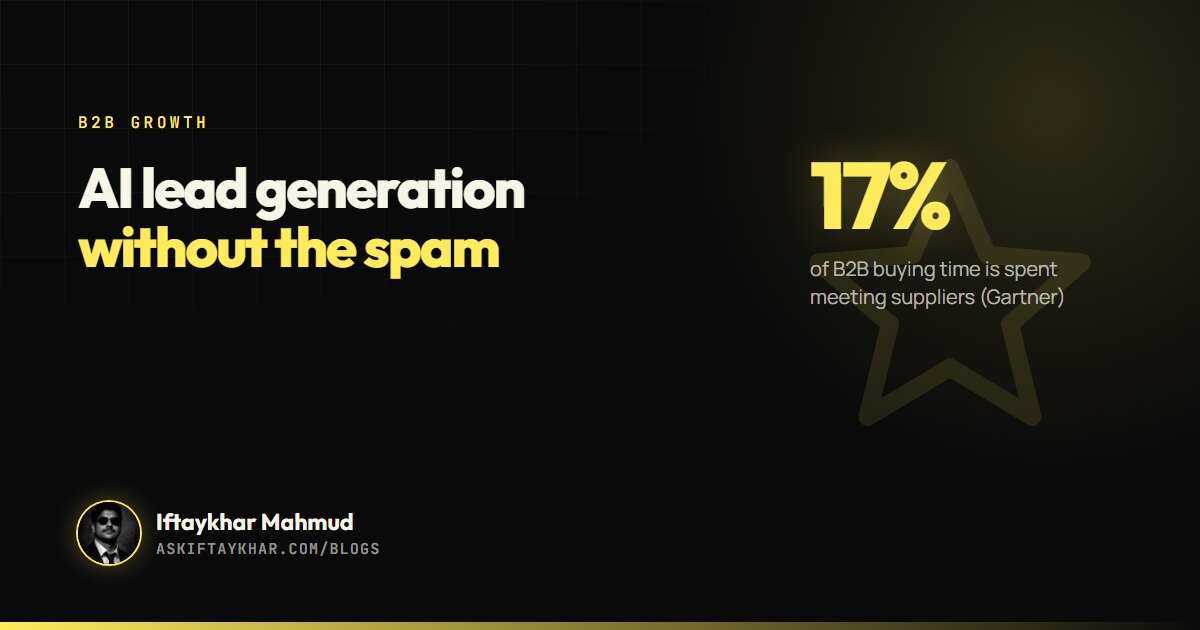
Gartner research shows B2B buyers spend only about 17% of their buying time meeting potential suppliers.
Complex purchases typically involve a buying group of six to ten decision makers, so one contact per company is rarely enough.
Define your ideal customer profile from your best existing customers, then add timing triggers.
Use AI for research and first drafts, and keep a person on final review before anything is sent.
The pitch you hear everywhere now goes something like this: plug an AI tool into a database, generate thousands of “personalised” emails, and watch the meetings roll in. I understand the appeal. I also know what happens next. Reply rates are poor, spam complaints climb, the sending domain gets flagged, and the team concludes that outbound does not work.
Outbound works. Volume-first outbound does not. AI lead generation earns its keep when it helps you find the right companies at the right moment and say something relevant, not when it helps you say nothing to more people.
Why buyers are harder to reach than ever
Gartner’s research on B2B buying paints a clear picture. Buyers spend only about 17% of their total buying time meeting with potential suppliers, and when they are comparing several vendors, each one gets a small slice of that. Much more of their time goes to independent research online.
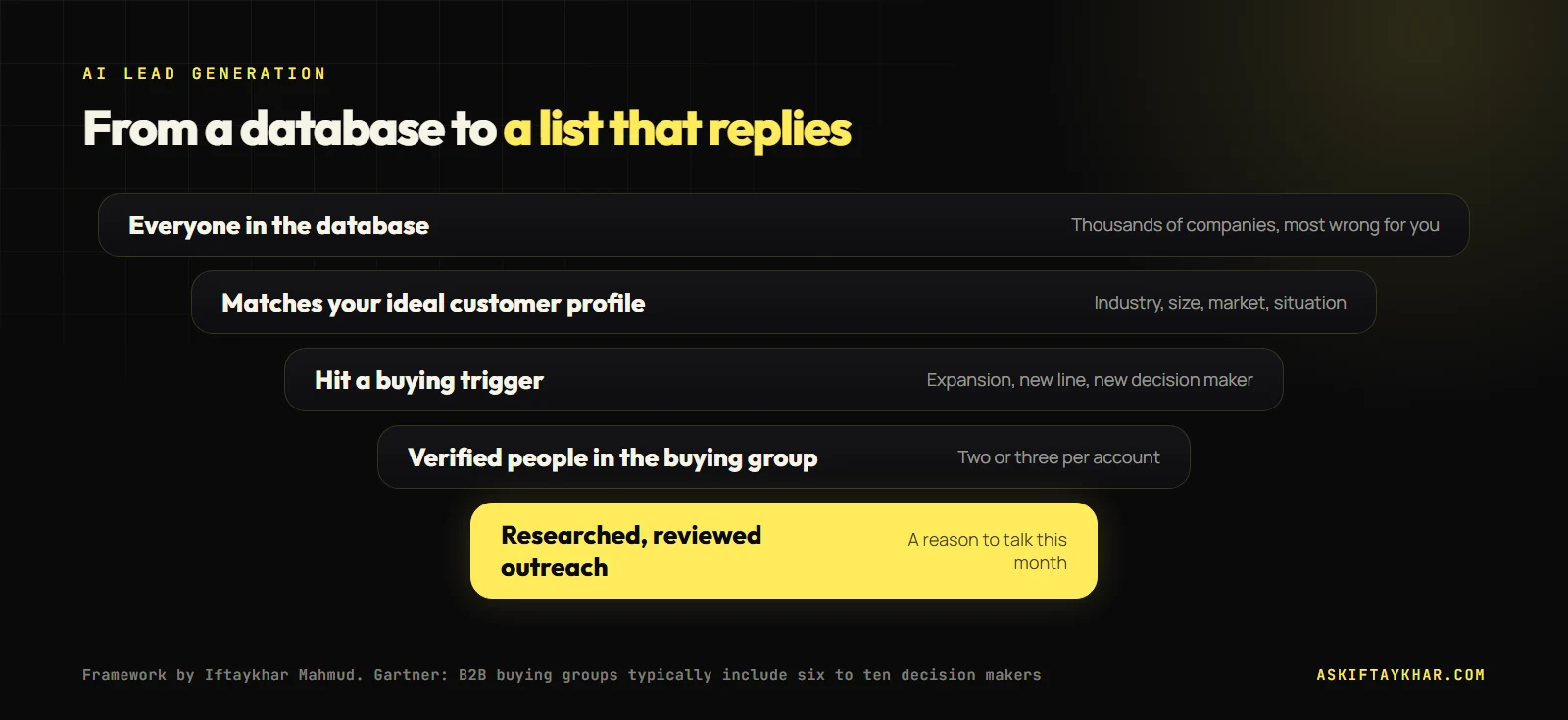
Gartner also reports that a typical buying group for a complex B2B solution involves six to ten decision makers. So even when you reach the right company, one contact is rarely the whole story.
The lesson for outbound is simple. You get very few chances to be considered, so each contact has to count. That points to precision, not volume.
Step 1: define your ideal customer profile from real customers
An ideal customer profile (ICP) describes the companies most likely to buy from you and succeed with you. The mistake is writing it from imagination. I build it from the best existing customers.
List your ten best clients by revenue, ease of working together and results. Then look for what they share:
Industry and niche: not “retail”, but “independent fashion labels selling online and through two to five stockists”.
Size: headcount or revenue range where your offer fits.
Location and markets: where they are based and who they sell to.
Situation: what was happening in their business when they hired you.
That last point is the one most ICPs miss, and it leads straight to step 2.
Step 2: add buying triggers
A trigger is an event that makes a company more likely to need you now. Triggers turn a list of good-fit companies into a list of good-fit companies with a reason to talk this month.
Useful triggers include a new funding round or expansion, a new location opening, hiring for a role your service supports, a new product line, a new head of marketing or sourcing, or visible signs of the problem you solve, such as a website that has not been updated in years.
A prospect who fits your profile and just hit a trigger is worth ten who only fit the profile.
Precision beats volume: each filter makes the final list smaller and more likely to reply.
Step 3: use AI lead generation tools for research and enrichment
This is where AI saves real time. Starting from a database such as LinkedIn Sales Navigator or Apollo, I filter by the ICP, then use AI to do the research a person would do by hand:
Read each company’s website and summarise what they sell and to whom.
Check for the triggers above in news, job posts and social profiles.
Flag companies that do not actually fit, which databases sometimes get wrong.
Find the likely members of the buying group, not just one job title.
The output is a short research note per company that a salesperson can read in thirty seconds.
Step 4: verify before you send anything
Every email address gets verified before it enters a sequence. Bounces damage sender reputation quickly, and a list with a high bounce rate can undo months of careful domain warm-up. I also remove anyone who has previously opted out and keep suppression lists synced across tools.
The deliverability rules that make this non-negotiable are covered in why emails land in spam.
Step 5: personalise with substance, then review
AI is excellent at turning a research note into a first line that shows you did your homework. The difference between good and bad personalisation is substance. “I noticed you’re in the fashion industry” is not personalisation. “Saw you just added a second stockist in Melbourne; that usually means the online store has to carry more of the brand story” is.
A person reviews every message before it goes out. It takes minutes per batch and catches the occasional confident AI mistake before a prospect sees it.
Where AI lead generation goes wrong
The same tools that save hours can also embarrass you in front of a prospect. These are the failure modes I design around.
Confident mistakes. A model summarising a website can misread what a company sells or invent a detail. The research note is a starting point, and anything specific you mention in a message should be checked.
Fake personalisation. Mentioning someone’s university or a two-year-old post to prove you “researched” them reads as a trick. Personalise around their business situation, not their biography.
Automation without judgement. Tools that send, follow up and “reply” with no person involved can keep emailing someone who asked to stop, or answer a real question badly. Every sequence needs a human watching the replies.
Ignoring the rules. Opt-outs, suppression lists and local privacy law still apply when AI writes the email. A good process makes compliance automatic rather than optional.
What this looked like for a manufacturer and a studio
For Mascot Knits Limited, a ready-made garment manufacturer in Savar, Dhaka, the work was opening doors with international buyers through targeted LinkedIn outreach built on researched buyer lists, backed by a Meta brand presence that made each cold conversation warmer. That is the ICP-first approach in a sector where every buyer relationship is valuable.
For SnapGenix, a photography studio positioned as a premium brand, outbound sequences turned attention into booked shoots. Different market, same principle: a focused list and a relevant reason to reach out.
My ICP-first list build, in order
Top ten customers analysed for shared traits and the situation they were in.
ICP written in one paragraph, with three to five buying triggers.
Database filtered by the ICP, then enriched and cleaned with AI research.
Every contact verified; suppression lists applied.
Messages drafted with AI from the research notes, reviewed by a person, sent in small batches.
How big should the list be?
Smaller than you think. A few hundred well-researched, trigger-matched companies often produce more conversations than several thousand generic ones, with far less risk to your domain. Start small, learn which triggers and messages work, then scale what works.
AI lead generation uses AI to find, research, filter and personalise outreach to potential customers. The best use is research and first drafts on a carefully chosen list, with a person reviewing before anything is sent.
What is an ideal customer profile?
An ideal customer profile describes the type of company most likely to buy from you and succeed with you: industry, size, location, markets and the situation they are in. Build it from your best existing customers rather than from guesswork.
What are buying triggers in B2B sales?
Buying triggers are events that make a company more likely to need your offer now, such as expansion, new funding, a new product line, a new decision maker or hiring for a related role.
Can prospects tell when outreach is written by AI?
Often, when the personalisation is shallow. Messages built on real research about the company, and reviewed by a person, read as thoughtful. Generic flattery written at scale is easy to spot.
How many prospects should I contact per month?
Start with a few hundred well-matched companies, not thousands. Learn which triggers and messages get replies, protect your sending domain, and scale only what works.
Small B2B teams do not need a complex scoring engine. They need a clear way to decide which leads get a call today. Here is a two-part scoring model you can run in a spreadsheet this week.
 Iftaykhar MahmudGrowth marketer, Dhaka