Skip to content

LinkedIn Cold Outreach for B2B Manufacturers: Starting Buyer Conversations From Bangladesh

Most factory outreach on LinkedIn is a copy-pasted capability pitch sent to anyone with "buyer" in their title. Here is the research-led approach I use to start real conversations with international buyers.

LinkedIn cold outreach for B2B manufacturers guide cover with Bangladesh garment export figures, by Iftaykhar Mahmud
On this page
  1. Why garment buyers are hard to reach from Bangladesh
  2. Step 1: choose accounts, not contacts
  3. Step 2: map the buying group
  4. Step 3: research before the first message
  5. Step 4: a LinkedIn cold outreach sequence that respects the buyer
  6. Do not automate LinkedIn outreach
  7. Warm the conversation before it starts
  8. Pair LinkedIn with email carefully

Short answer

LinkedIn cold outreach for a B2B manufacturer works when you contact the right people inside a small number of well-researched buyer accounts, lead with relevance rather than a capability pitch, and follow up with something useful over a few weeks. Every step should be done by a person, because LinkedIn's rules prohibit bots and automated messaging.

Key takeaways

  • Bangladesh exported about $38.8 billion of garments in 2025 and remains the world's second-largest apparel exporter, so buyers hear from many suppliers.
  • Gartner reports complex B2B purchases involve six to ten decision makers, so map the buying group, not one contact.
  • Connect without a pitch, add value in the second touch, and ask for a conversation only after that.
  • A visible, active company presence makes every cold message warmer before it is read.
If you work in sourcing for a fashion brand, your LinkedIn inbox has a familiar look. A connection request from a factory, then within minutes a long message: “We are a leading manufacturer of knit and woven garments with 20 years of experience, BSCI certified, competitive prices, please find our company profile attached.” Multiply by twenty a week.

Nothing in that message is false. It is just identical to every other one. LinkedIn cold outreach for manufacturers works when the buyer can tell, within one line, that you looked at their business specifically. This guide covers how I approach it, using the garment sector as the example.

Why garment buyers are hard to reach from Bangladesh

The competition is real. Bangladesh exported about $38.82 billion of garments in 2025 according to WTO figures reported by The Business Standard, keeping its place as the world’s second-largest apparel exporter after China, with Vietnam close behind at about $37.51 billion. Every one of those exporters wants the same buyers’ attention.

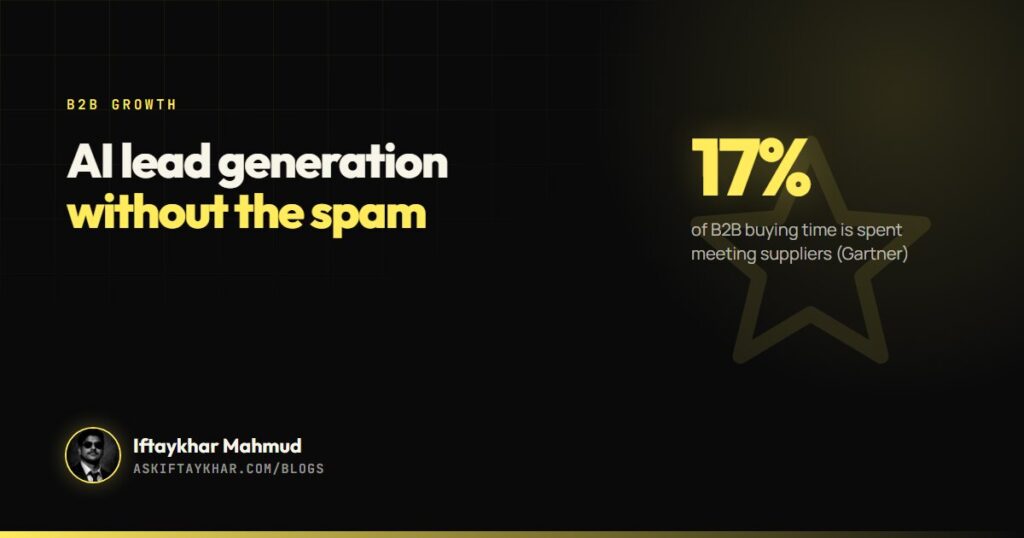
Buyers also have little time for suppliers they do not know. Gartner’s research shows B2B buyers spend only about 17% of their buying time meeting potential suppliers, and a complex purchase typically involves a buying group of six to ten decision makers. In apparel, that group might include sourcing, product development, merchandising, compliance and quality.

The implication is clear. A generic pitch to one “buyer” title is easy to ignore. A relevant message to the right two or three people in a well-chosen account is not.

Step 1: choose accounts, not contacts

Start with brands, not people. I build a short list of buyer accounts that genuinely match what the factory does well:

  • Product fit: the categories and fabrics they sell match your capabilities, such as knits, woven bottoms or outerwear.
  • Order profile: their likely order sizes and lead times suit your production.
  • Market fit: they sell in markets you already ship to or have compliance for.
  • Compliance fit: the certifications and audits they require, such as amfori BSCI, WRAP, OEKO-TEX or GOTS, are ones you hold or can obtain.

This is the same ideal customer profile thinking I describe in building an ICP-first prospect list, applied to a manufacturing sector.

Step 2: map the buying group

For each account, identify two or three people rather than one. Sourcing managers and category buyers own supplier decisions. Product developers and technical designers care about what you can make. Compliance and sustainability teams care about your audits. Each needs a slightly different reason to talk.

Step 3: research before the first message

Spend ten minutes per account. What did they launch this season? Which categories are they expanding? Have they announced sourcing diversification, a sustainability target or a new market? That research is what turns a pitch into a conversation. AI tools can speed up the reading, but the judgement about what is relevant should stay with a person.

Step 4: a LinkedIn cold outreach sequence that respects the buyer

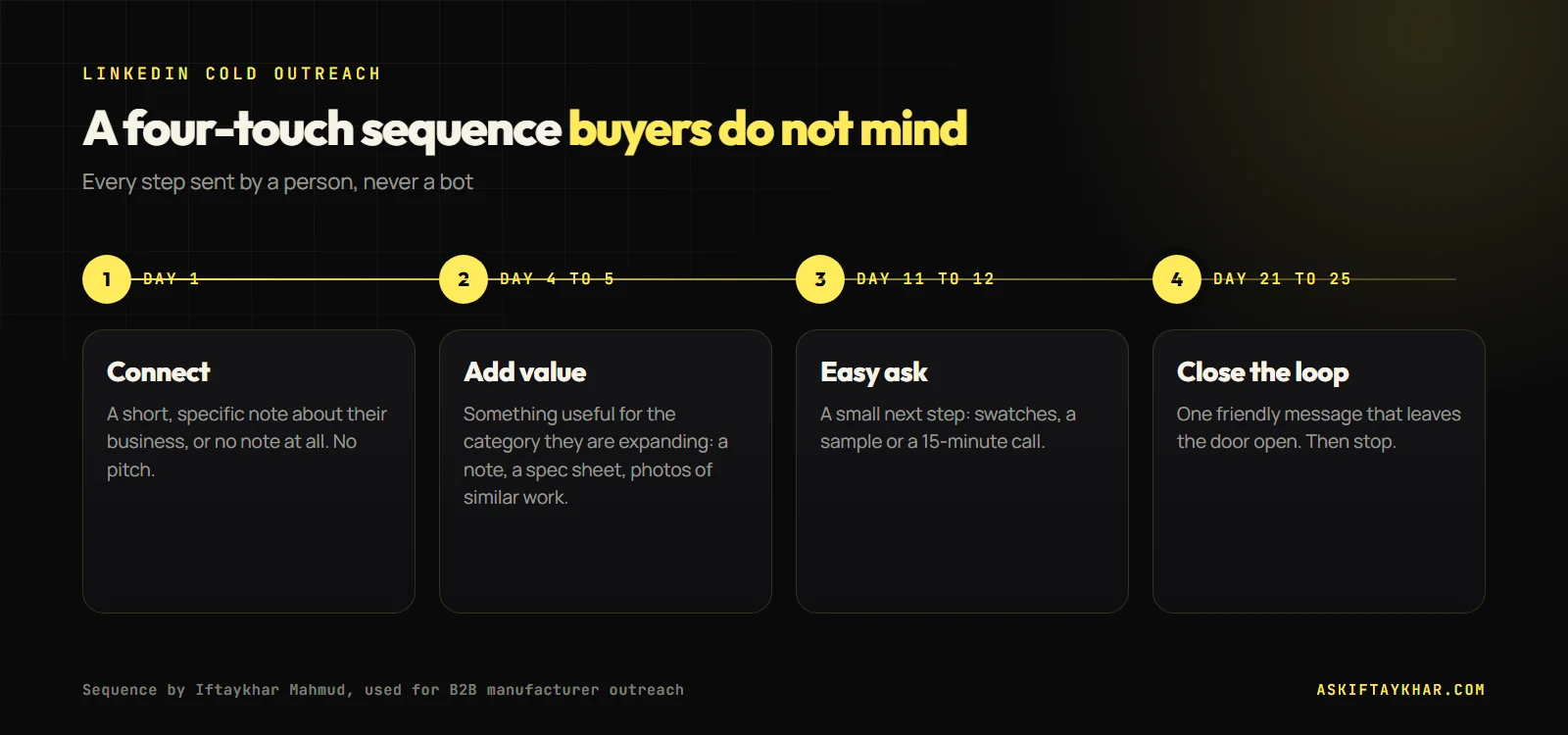
LinkedIn cold outreach sequence for B2B manufacturers in four touches: connect, add value, easy ask and close the loop over about three weeks
Four touches over about three weeks, every one sent by a person.

Touch 1: connect with a short, specific note, or none

Keep the note short enough to read in a notification preview. Mention something specific and do not pitch. “Saw your new organic cotton basics line. We make similar knit programmes for European brands and follow your sustainability updates closely. Happy to connect.” Many buyers prefer no note at all to a sales pitch disguised as a note.

Touch 2: add value after they accept

A few days after connecting, send something useful and relevant to what you learned: a short note on fabric price movements, a relevant capability sheet for the exact category they are expanding, or photos of a similar programme you produced. Still no hard ask.

Touch 3: a clear, easy ask

About a week later, ask for a small next step. “Would it help if I sent two sample swatches for the jersey you are using in the new line?” A sample or a 15-minute call is easier to agree to than “a meeting to discuss our capabilities”.

Touch 4: close the loop politely

If there is no reply after another week or two, send one short, friendly message that leaves the door open, then stop. Silence is an answer for now, not forever.

Do not automate LinkedIn outreach

LinkedIn’s User Agreement prohibits using bots or other automated methods to access the service, add contacts or send messages. Accounts that use automation tools risk restrictions, and buyers can usually tell. Everything in the sequence above is done by a person. Where AI helps is before the message: research, summarising and first drafts that a person rewrites.

LinkedIn also limits how many invitations an account can send each week. Staying well within that limit is easy when every invitation goes to a researched account.

Warm the conversation before it starts

A buyer who accepts your request will look at your profile and your company page. If they find an empty page, the message loses credibility. If they find recent posts about production, quality control, certifications and finished programmes, the cold message suddenly looks like a real, active supplier.

The same principle shaped the work for Mascot Knits Limited, a ready-made garment manufacturer in Savar, Dhaka, founded in 2006 and producing knit and woven apparel for international buyers. International buyer prospecting had been relationship-led only. The work combined targeted LinkedIn cold outreach from researched buyer lists with a Meta brand presence, so first contact with new buyers was warmer, with brand context in place before the conversation started.

My weekly routine for manufacturer outreach

  1. Add five to ten new researched accounts to the list.
  2. Send connection requests to two or three people per new account.
  3. Send value messages to everyone who accepted in the last few days.
  4. Send asks to those who received value last week.
  5. Post two or three times on the company and founder profiles.
  6. Log every reply, sample request and meeting in one sheet or CRM.

Pair LinkedIn with email carefully

Some buyers never reply on LinkedIn but do read email. A short, relevant email to a researched contact can complement the LinkedIn sequence, as long as it comes from a properly authenticated domain and stays low volume. The structure I use is in the cold email sequence that books meetings.

Research-led outreach like this is what my cold outreach and prospecting service covers, the brand presence side runs through Meta marketing, and list building sits in AI lead generation. You can read more about my background, including my work with Bangladeshi and international businesses, on the About page.

Frequently asked questions

How do manufacturers find buyers on LinkedIn?

Start with a short list of brands whose products, order sizes, markets and compliance needs match what you make. Then map two or three people in each buying group, such as sourcing, product development and compliance, and research each brand before contacting anyone.

What should I write in a LinkedIn connection request to a buyer?

Something short and specific to their business, with no pitch, or no note at all. Mention a real detail, such as a new product line, and simply ask to connect. Save your capabilities for later messages.

Can I use automation tools for LinkedIn outreach?

LinkedIn's User Agreement prohibits bots and automated methods for adding contacts or sending messages, and accounts using them risk restrictions. Use AI for research and drafting, and send every message yourself.

How many LinkedIn connection requests can I send per week?

LinkedIn applies a weekly invitation limit and does not publish a fixed number for every account. With a research-led approach you will stay far below it, because each request goes to a carefully chosen person.

How long before LinkedIn outreach produces meetings?

Expect several weeks. Each account needs a connection, a value message and an ask, spaced a few days to a week apart, and buyers often reply when their own sourcing calendar makes it relevant.

Keep reading

All articles
Start the conversation

Tell me where
growth is stuck.

Send the brief below or grab a 30-minute discovery slot. You will get a straight answer on whether I can move your numbers, and exactly how.

Send your query

Every field helps me answer properly the first time.