Before You Trust Smart Bidding: The Google Ads Conversion Tracking Checklist
Target CPA and Target ROAS can only optimise toward what you measure. If your conversion tracking counts the wrong things, Smart Bidding will get very good at buying the wrong things. Here is the checklist I run first.
 Iftaykhar MahmudGrowth marketer, Dhaka
Published 6 min read
On this page
Short answer
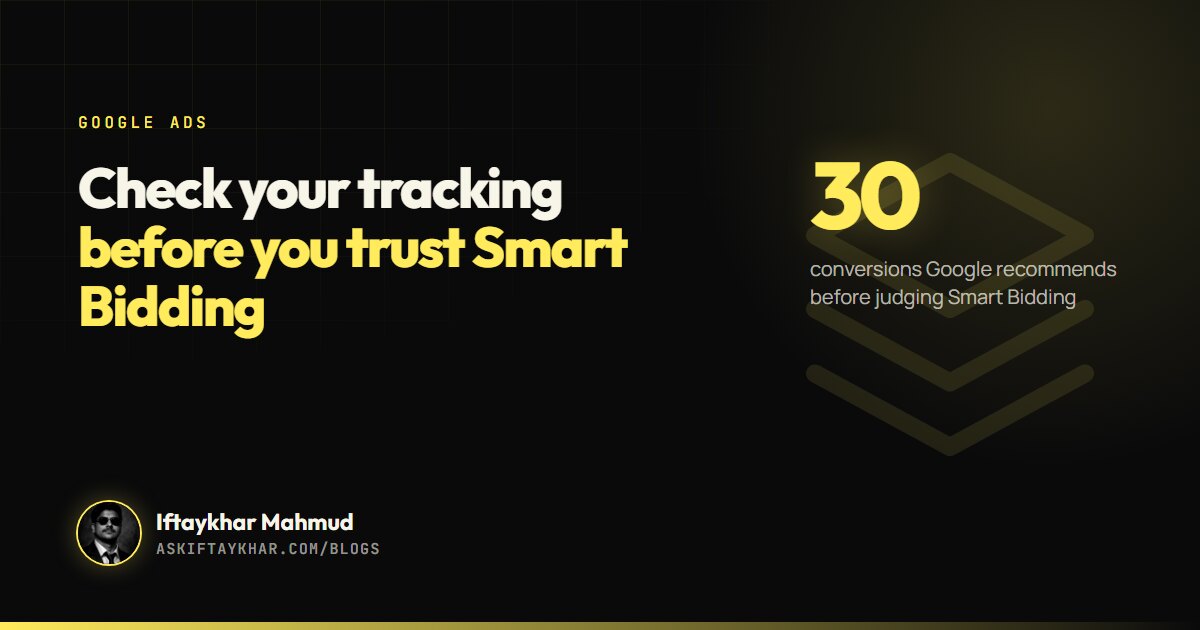
Google Ads conversion tracking should record only the actions that mean real business value, with sensible values, deduplication and enhanced conversions switched on, and ideally qualified leads or sales imported from your CRM. Smart Bidding needs that clean data: Google recommends judging it over a period with at least 30 conversions, or 50 for Target ROAS.
Key takeaways
- Smart Bidding learns from your conversion data, so bad tracking becomes bad bidding.
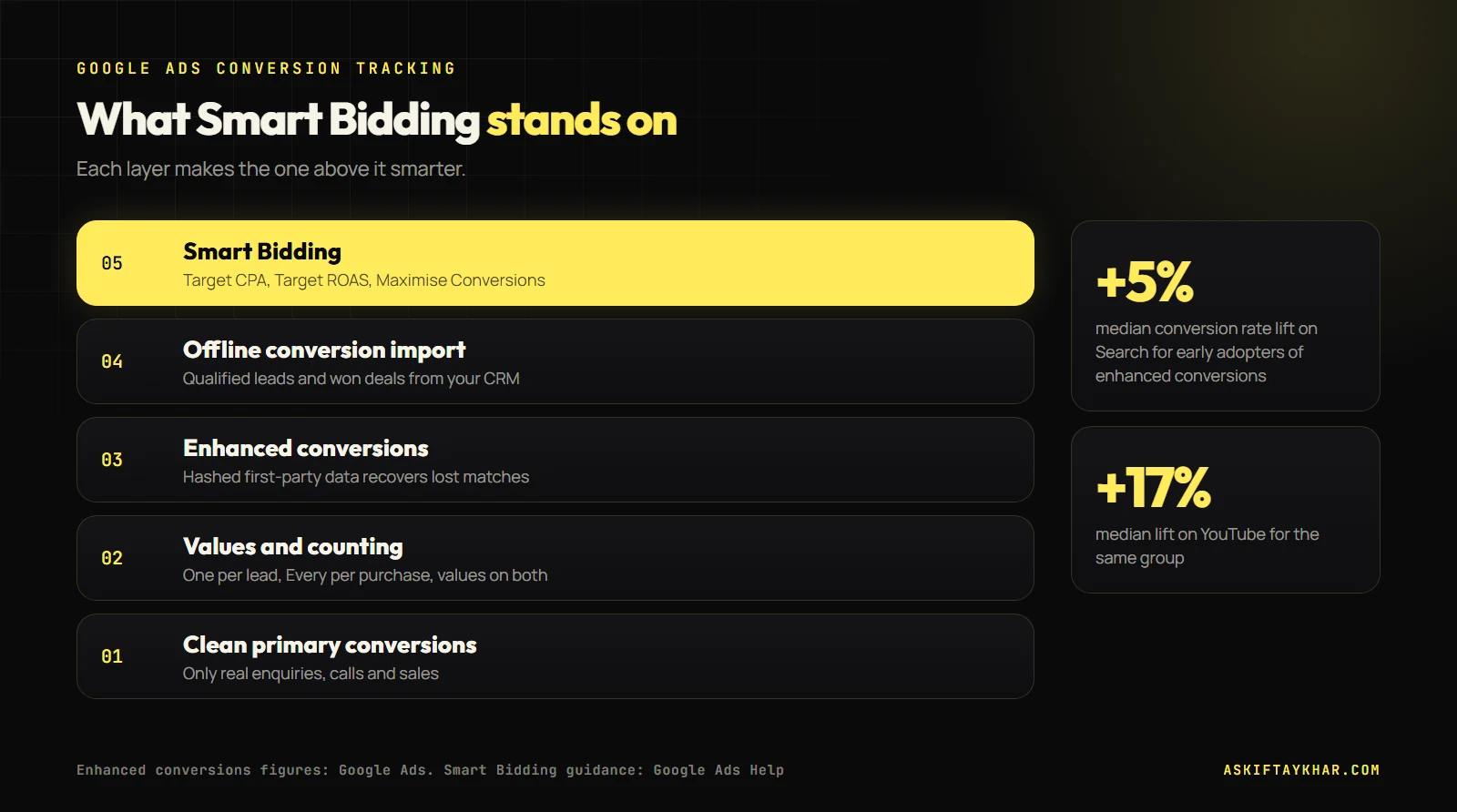
- Keep one or two primary conversion actions that represent real value and set the rest to secondary.
- Google reports a median conversion rate increase of 5% on Search and 17% on YouTube for early adopters of enhanced conversions.
- Import qualified leads or sales from your CRM so bidding optimises toward revenue, not form fills.
Frequently asked questions
How many conversions does Smart Bidding need?
Google recommends evaluating Smart Bidding over a period that includes at least 30 conversions, or 50 for Target ROAS, and Target ROAS has a minimum conversion history before it can be used. Accounts with fewer conversions can still use Maximise Conversions, but results will be less stable.
What are enhanced conversions in Google Ads?
Enhanced conversions send hashed customer data from your conversion page, such as an email address, to help Google match conversions it would otherwise miss. Google reports a median conversion rate increase of 5% on Search and 17% on YouTube for early adopters.
Should I count leads as Every or One?
Usually One. A person who submits the same form twice is one lead. Purchases are usually counted as Every, because each order has its own value.
What is offline conversion import?
It is uploading outcomes that happen after the click, such as a qualified lead or a closed sale, back into Google Ads. You store the click ID from the ad with each lead and upload the outcome, so bidding learns which searches lead to real customers.
Why did my costs go up after switching to Target CPA?
Often because the target was set lower than the account's real cost per conversion, or because the conversion data included low-value actions. Set the target close to your recent actual cost per conversion and clean up primary conversions before tightening it.
Keep reading
All articles
Google Ads
Google Ads for Local Service Businesses: 9 Settings That Quietly Waste Your Budget
Most local Google Ads accounts do not fail because of bad keywords. They fail because of default settings that send money to people outside the area, to the wrong network, or to searches that were never going to buy.