Organic Social Media for Small Businesses: Post Less, Get Shared More
Posting every day burns small teams out and rarely grows anything. Here is what Instagram says it rewards now, and the simple content system I use to post less while earning more shares.
Social media management for a small business works best with fewer, better posts built to be watched and shared, not daily posting for its own sake. Instagram's head has said watch time, likes per reach and sends per reach matter most, with sends especially important for reaching new people. Plan content around a few clear pillars and a rhythm you can sustain.
Key takeaways
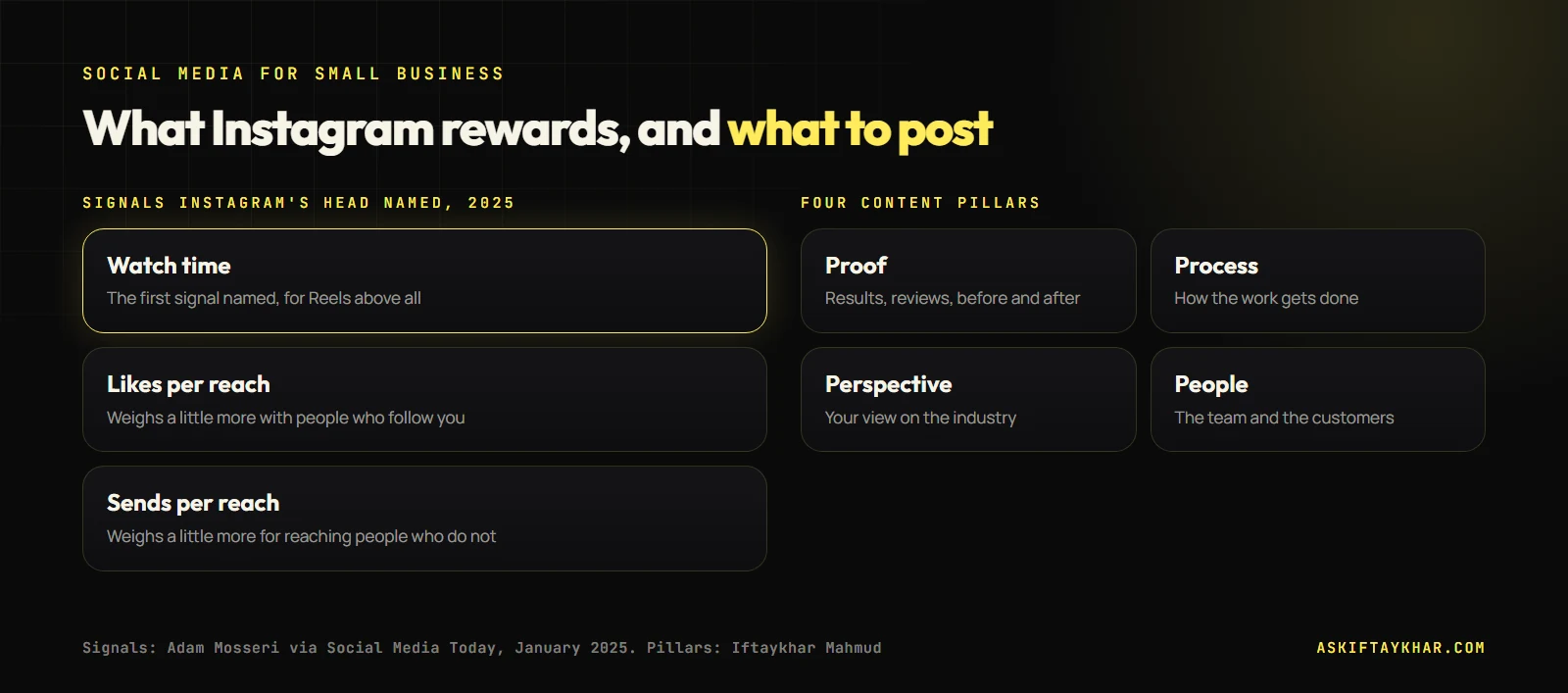
Instagram's head Adam Mosseri named watch time, likes per reach and sends per reach as the signals that matter most.
Sends (people sharing your post in a DM) matter more for reaching people who do not follow you yet.
Four content pillars keep a small business consistent: proof, process, perspective and people.
Three strong posts a week that you can sustain beat seven rushed ones that stop after a month.
Plenty of small business owners feel guilty about social media. They know they should post more. They start strong, post every day for two weeks, run out of ideas and time, and go quiet for a month. Then the cycle repeats.
The guilt is aimed at the wrong thing. Volume was never the point. Social media for small business works when you make a few posts that people watch to the end and send to a friend, then do that consistently enough that the account becomes known for something.
What Instagram says it rewards now
You do not have to guess how ranking works. Instagram has explained it publicly several times.
In its 2023 ranking explainer, Instagram described separate systems for Feed, Stories, Explore and Reels, each using signals such as what a person has liked, saved, reshared and commented on, and how popular a post is. In January 2025, Instagram head Adam Mosseri went further and named the three signals that matter most: watch time, likes per reach and sends per reach. He explained that likes weigh a little more for people who already follow you, while sends weigh a little more for reaching people who do not.
What Instagram's head said matters most, and the four pillars I use to plan small business content.
That changes what a good post looks like. A post built for sends is one someone would forward to a specific person: “this is exactly what I was telling you about”. Tips that solve a real problem, a surprising before and after, a local recommendation, a relatable moment. A generic product photo with a caption about how excited you are rarely gets sent to anyone.
The four content pillars I use for small businesses
Running out of ideas is a planning problem. I give every small business account four pillars, and every post belongs to one of them.
Proof
Evidence that you deliver: results, reviews, before and after, finished work, customer messages. For a service business this is the pillar that sells.
Process
How you do what you do: behind the scenes, the steps, the tools, the craft. People trust what they can see being made or fixed.
Perspective
Your opinion on your industry: common mistakes, myths, what customers should ask before buying. This is what makes an account worth following rather than just buying from.
People
The faces behind the business and the customers it serves. Small businesses have an advantage here that big brands cannot copy: the owner is real and reachable.
A weekly rhythm you can keep up
Consistency beats intensity. This is the rhythm I recommend for a small team with a few hours a week:
Day
Format
Pillar
Built for
Monday
Short vertical video (Reel)
Perspective or process
Watch time and sends
Wednesday
Carousel
Proof
Saves and sends
Friday
Reel or photo post
People or proof
Likes from followers
Daily, when there is something real
Stories
Any
Staying top of mind with followers
Three posts a week is enough to build an account if each one is made with care. Stories fill the gaps with low effort: polls, quick updates, replies to questions.
Make one piece of content do five jobs
The easiest way to sustain a rhythm is to stop creating every post from scratch. One long piece of content can feed a week.
The same idea works for my own podcast. The Founder Frames is a founder interview series on my YouTube channel, and a single conversation can become several short clips, a quote graphic, a carousel of lessons and a newsletter note. Recording once and editing several ways is far easier than inventing five new ideas.
A local business can do the same with a single customer job: film the before, the process and the after, then use it across a Reel, a carousel, a Story sequence and a Google Business Profile update.
Where organic and paid social meet
Organic content is the best free testing ground for paid ads. A post that earns unusual shares and watch time organically is a strong candidate to put money behind, because people have already shown it works. That is why I treat organic social and paid Meta campaigns as one system, and why creative testing on Meta often starts with what worked organically.
For Healthy Eats, appetite-first creative built to stop the scroll turned into order volume and a recognisable name inside the delivery zone. For SnapGenix, a photography studio, positioning as a premium brand rested on portfolio proof, which is the proof pillar doing its job.
My monthly social media planning session
Look at last month’s posts ranked by sends and average watch time, not likes.
Note which pillar and format the top three came from.
Plan twelve posts for the month: three per week, spread across the four pillars.
Batch-produce content in one or two sessions rather than every day.
Pick the strongest organic post and test it as a paid ad.
Reels that earn watch time
Because watch time is the first signal Mosseri named, short vertical video deserves the most care. A few habits make a large difference:
Show the payoff in the first second. The finished result, the surprising number, the problem on screen. Do not open with a logo or a greeting.
Keep it as short as the idea allows. A tight 15-second clip that people watch twice beats a 60-second one they leave at second eight.
Add on-screen text. Many people watch without sound, and text also tells Instagram what the video is about.
End with a reason to send it. “Send this to someone who needs a new phone screen” is a plain, honest prompt that fits the sends signal.
The numbers worth tracking each month
Instagram’s own insights give you everything you need. I track five numbers per post and look at them monthly, never daily.
Metric
Why it matters
Where to find it
Sends per reach (shares / accounts reached)
The strongest sign of content people value
Post insights
Average watch time
The first signal Instagram’s head named
Reel insights
Saves
People planning to come back to it
Post insights
Profile visits and link clicks
Interest turning into action
Post and account insights
Enquiries from social
The business result
Your DMs, forms and bookings
If a post has modest likes but unusual sends, treat it as a winner. It is telling you what your audience wants more of.
Social media for small business: what to stop doing
Posting because the calendar says so, with nothing to say.
Chasing every trend regardless of whether it fits your customers.
Measuring success by follower count alone.
Being on every platform half-heartedly. Two platforms done well beat five done badly.
If you would rather hand this over, planning and running content is what my social media management service covers, and when organic winners are ready for budget, Meta marketing takes over. You can read more about me and the podcast on the About page.
How often should a small business post on social media?
Three strong posts a week on your main platform, plus Stories when there is something real to share, is enough for most small businesses. Consistency over months matters more than daily volume for a few weeks.
What does Instagram reward most in 2025 and 2026?
Instagram head Adam Mosseri has named watch time, likes per reach and sends per reach as the most important signals. Likes matter a little more with existing followers, and sends matter a little more for reaching new people.
What should a small business post on Instagram?
Plan around four pillars: proof (results and reviews), process (how you work), perspective (your view on the industry) and people (the team and customers). Every post should belong to one of them.
Is organic social media still worth it for small businesses?
Yes, especially as a trust builder and a free testing ground for ads. People check a business's social profiles before buying, and organic posts that perform well are strong candidates for paid promotion.
Which social media platform should a small business focus on?
The one where your customers already spend time and where your product shows well. For most local and consumer businesses that is Instagram and Facebook; for B2B it is usually LinkedIn. Start with one or two and do them properly.
When Ads Manager says a campaign failed but your till says otherwise, the problem is usually tracking, not the ads. Here is how the Meta Conversions API fixes it, step by step.
 Iftaykhar MahmudGrowth marketer, Dhaka