Creative Is the New Targeting: A Meta Ads Creative Testing System for Small Brands
With broad targeting now the default, your creative decides who sees your ads. This is the testing system I use to find winning concepts on a small budget without wasting spend on button colours.
Meta ads creative testing means running distinct creative concepts against each other, with enough budget per concept to see real results, and keeping only the ones that lower your cost per result. Test big ideas such as the angle, the hook and the format before small details, because creative now does much of the targeting work.
Key takeaways
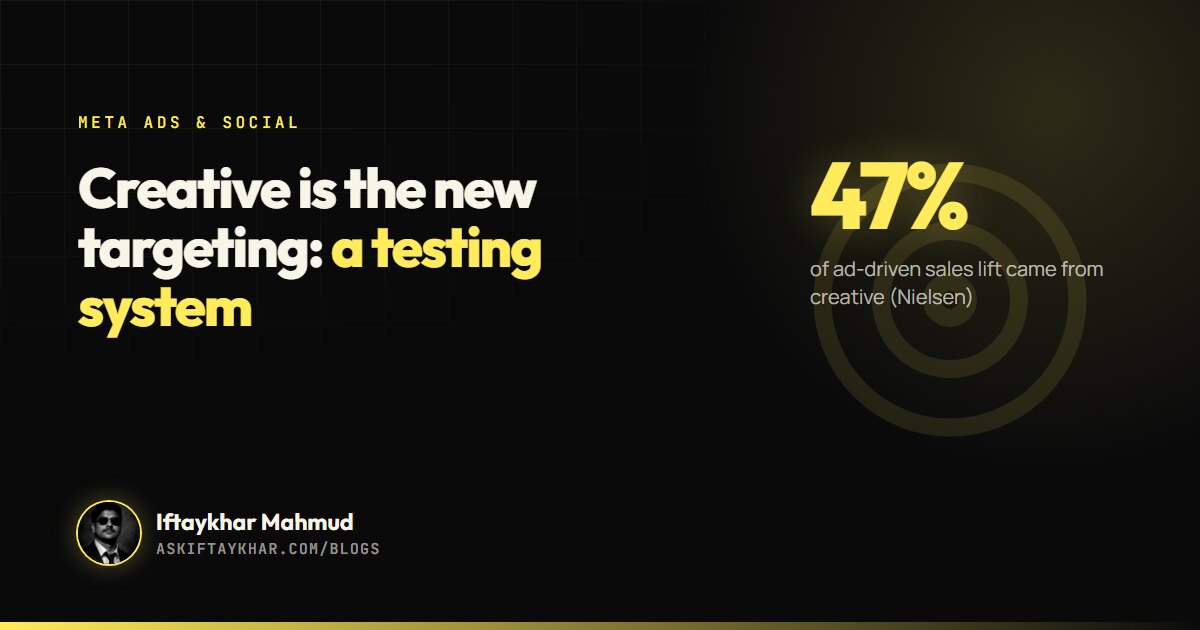
Nielsen attributed 47% of advertising-driven sales lift to creative in its study of nearly 500 campaigns, more than any media factor.
With broad audiences, the creative itself tells Meta who the ad is for.
Test concepts first, then hooks, then formats. Leave colour and button tweaks for last.
Give each concept enough spend to judge it: I set a kill rule at two to three times the target cost per result with no conversions.
Ten years ago, the clever part of running Facebook ads was the targeting. You stacked interests, layered behaviours and excluded everyone who looked slightly wrong. That skill still exists, but it matters far less now. With broad audiences and Advantage+ audience doing most of the finding, the part of the ad that decides who sees it is the ad itself.
That is why Meta ads creative testing has become the main job in running Meta ads well. Not “make a few variations and see what happens”, but a system: what to test, in what order, with how much money, and when to stop.
Why creative carries so much weight
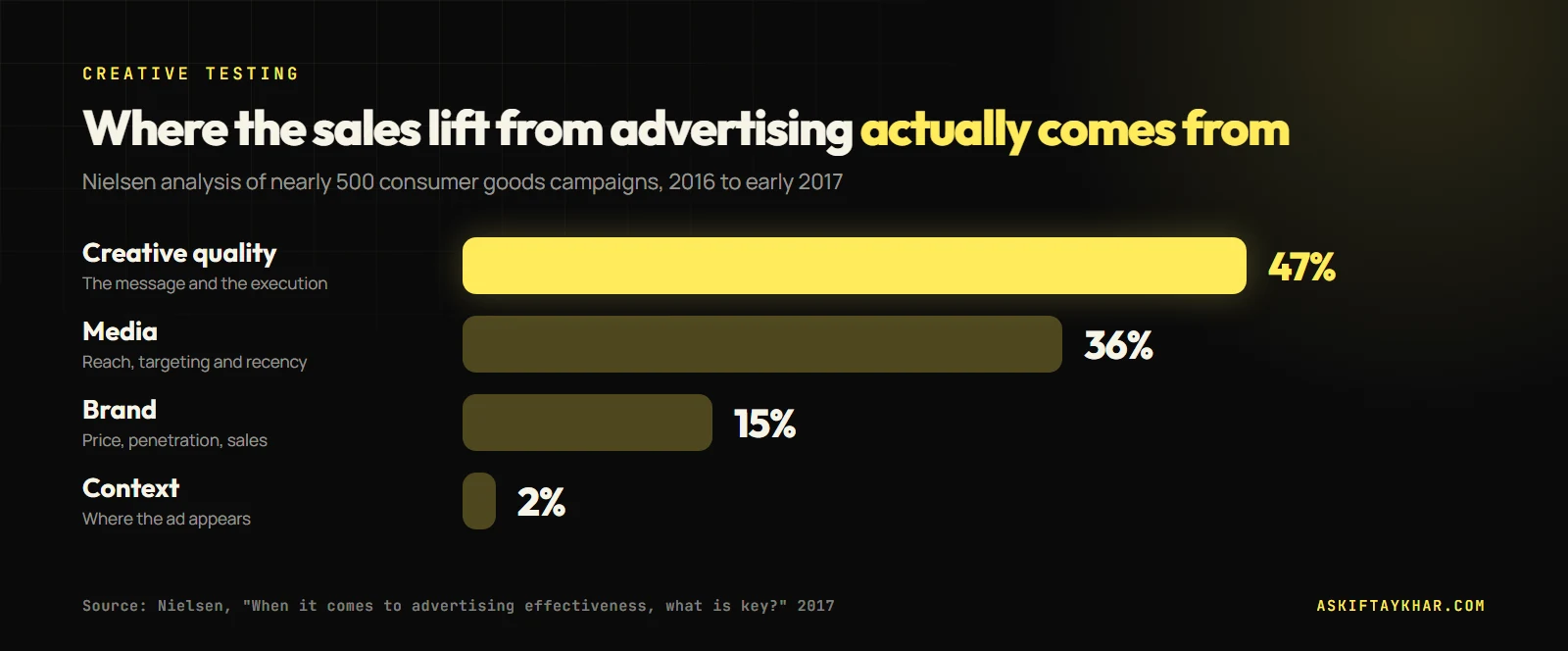
This is not a new idea, and it is not just a Meta talking point. Nielsen analysed nearly 500 consumer goods campaigns that ran in 2016 and early 2017 and broke down where the sales lift from advertising came from.
Nielsen's analysis of nearly 500 consumer goods campaigns attributed 47% of advertising-driven sales lift to creative.
Creative quality accounted for 47% of the sales contribution, more than reach, targeting and recency combined at 36%. Brand factors made up 15% and context about 2%. The study covered traditional and digital media, but the lesson carries straight into a Meta account: the thing you control most directly is also the thing that moves results most.
There is a second, more technical reason. When your audience is broad, Meta reads signals from the ad: the words, the visuals, who stops and who engages. A video about toddlers’ bedtime routines will find parents of toddlers even if you never typed the word “parent” into the targeting. Your creative has become your targeting brief.
Meta ads creative testing in three layers
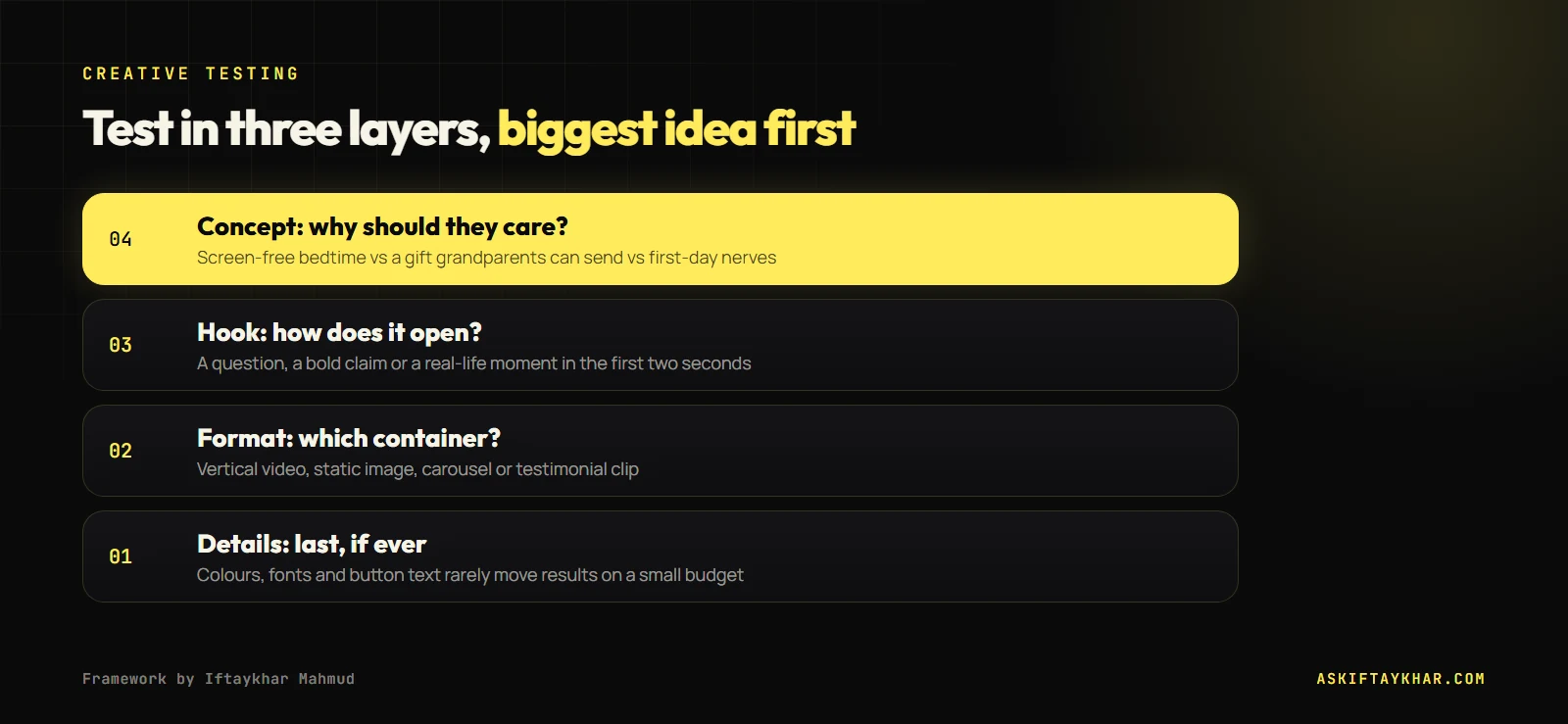
A common mistake is testing the smallest things first. Two versions of the same video with different button text, or the same image in two colours. Those tests almost never produce a difference big enough to matter on a small budget. I test in three layers, from biggest to smallest.
Layer 1: the concept
A concept is the core idea of why someone should care. For a children’s book brand, three very different concepts might be “screen-free bedtime”, “a gift grandparents can send” and “a book that helps with first-day-of-school nerves”. Each speaks to a different buyer and a different moment. Concepts are where the large wins live.
Layer 2: the hook
Once a concept works, test how it opens. The first line of copy and the first two seconds of video decide whether anyone sees the rest. Same concept, three openings: a question, a bold claim, a moment from real life.
Layer 3: the format
Only then test the container: a short vertical video, a static image, a carousel, a user-style testimonial clip. Formats matter, especially because Reels and Stories reward vertical video, but they rarely rescue a weak concept.
Test the biggest idea first: concept, then hook, then format. Small details come last.
How much to spend on each test
Creative testing fails on small budgets when the money is spread so thin that nothing gets a fair trial. Before a test, I decide two numbers.
The judging threshold: how many results a concept needs before I trust its cost per result. On a small account I accept a directional read after about 10 to 15 conversions per concept, knowing it is not statistically perfect.
The kill rule: if a concept spends two to three times my target cost per result and produces nothing, it stops. No second chances for the same idea in the same form.
That kill rule is my own habit rather than a Meta rule, and it keeps tests honest. If your target cost per lead is $20, a concept that has spent $60 with zero leads has told you enough.
Because each ad set still needs results to learn, I usually run the test inside one ad set with three to five concepts, rather than one ad set per concept. The budget math behind that choice is in my guide to the Meta ads learning phase.
Which metrics to read, in which order
Cost per result is the verdict, but it arrives slowly. These earlier signals tell you why an ad is winning or losing.
Metric
What it tells you
How I read it
Hook rate (3-second video plays / impressions)
Does the opening stop the scroll?
Weak hook, strong later metrics: rewrite the opening
Hold rate (ThruPlays / 3-second plays)
Does the story keep attention?
People leave early: shorten or restructure
Link click-through rate
Does the ad create intent?
High CTR, poor conversion: check the landing page
Cost per result
Does it make money?
The final decision, judged on enough volume
Hook rate and hold rate are not labels Meta shows by default. I build them as custom metrics from the video play columns in Ads Manager, and they are the fastest way to know whether a concept failed because of the idea or because of the first two seconds.
A creative brief that produces testable ads
Most weak creative comes from a weak brief. Before anything gets filmed or designed, I write one line for each of these:
Who exactly is this for? Not “women 25 to 45”, but “a parent buying a birthday present for a four-year-old”.
What moment are they in? Scrolling at night, planning a weekend, dealing with a broken phone right now.
What do they believe before seeing the ad? And what do we need them to believe after?
What is the proof? A review, a before and after, a number, a demonstration.
What is the single action? Order, book, call, message.
Creative testing mistakes that waste the budget
A few habits undo good creative work faster than anything else.
Changing several things at once. If the new ad has a new concept, a new hook and a new format, a win teaches you nothing you can reuse.
Killing ads on day two. Early results during learning swing widely. Judge on the threshold you set before the test, not on the first 48 hours.
Letting one ad take all the spend. Meta often pushes budget to an early favourite. If a concept never received a fair share, it has not really been tested; give it its own run.
Testing with no written hypothesis. “Parents respond to a bedtime angle more than a gifting angle” can be proven or disproven. “Let’s try some new stuff” cannot.
Ignoring comments. The comments under an ad are free research. Objections that appear there are the next concepts to test.
What this looks like with real brands
For Kidvive, a children’s book brand, the whole approach was taking the books to the parents who actually buy, through creative testing on Meta and sharper segmentation. For Healthy Eats, creative had one job: be appetite-first and stop the scroll inside a delivery zone. And for Icon Shopper, catalogue-led creative and seasonal offer cycles did the heavy lifting for repeat purchases.
Three different businesses, one shared pattern: the creative carried the targeting.
My weekly creative testing rhythm
Monday: review last week’s results against the judging threshold and kill rule.
Keep the winners running untouched. Retire the losers.
Brief two or three new concepts or hooks based on what won.
Launch the new ads together, once, so the ad set only relearns once.
Log every test in a simple sheet: concept, hook, format, spend, results, verdict.
The log is the part most people skip, and it is the most valuable after three months. Patterns show up: which angles work for which season, which hooks never land, which formats your audience ignores.
On a small budget, three to five distinct concepts in one ad set is enough. More than that spreads spend so thin that no single ad gets a fair trial.
How long should a Meta ads creative test run?
Until each concept reaches your judging threshold or hits the kill rule, usually one to two weeks on a small account. Judging in the first two or three days, while the ad set is still in learning, leads to wrong calls.
What should I test first in Facebook ad creative?
The concept: the core reason someone should care. Then the hook, the first line or first two seconds. Then the format. Colours, fonts and button text are the last things worth testing.
Should I use Meta's dynamic creative or Advantage+ creative?
They are useful for finding good combinations of existing assets, but they do not replace concept testing. I use them once I know which concepts work, not to discover the concepts in the first place.
Why do my ads get cheap clicks but no sales?
Usually the creative is attracting curiosity rather than buying intent, or the landing page breaks the promise the ad made. Check whether the people clicking match your buyer, and whether the page they land on continues the same message.
When Ads Manager says a campaign failed but your till says otherwise, the problem is usually tracking, not the ads. Here is how the Meta Conversions API fixes it, step by step.
 Iftaykhar MahmudGrowth marketer, Dhaka