Skip to content

How to Get Your Business Cited by ChatGPT and Google AI Overviews

More people now get answers from AI before they ever see a list of links. Here is what makes an AI assistant cite one business over another, and the exact steps I took on this website.

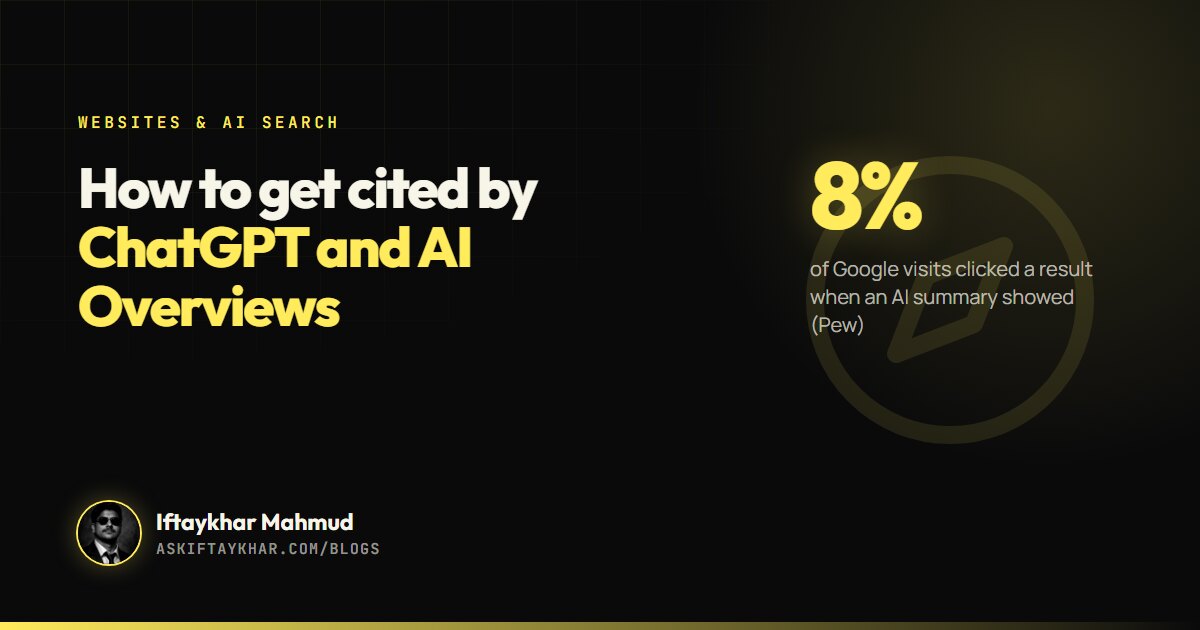
Guide cover on how to get a business cited by ChatGPT and Google AI Overviews, by Iftaykhar Mahmud
On this page
  1. Why AI answers now matter for small businesses
  2. How to get cited by ChatGPT: make your business a clear entity
  3. Write pages that are easy to quote
  4. Make sure AI crawlers can actually reach you
  5. Earn mentions on other trusted sites
  6. A client example: a service area machines can read
  7. How long does it take?

Short answer

To get cited by ChatGPT and Google AI Overviews, make your business easy for machines to identify and quote: one clear entity page, consistent profiles linked with schema, service pages that answer questions directly in the first few sentences, crawler access that is actually open, and mentions on other trusted sites. This is often called generative engine optimisation.

Key takeaways

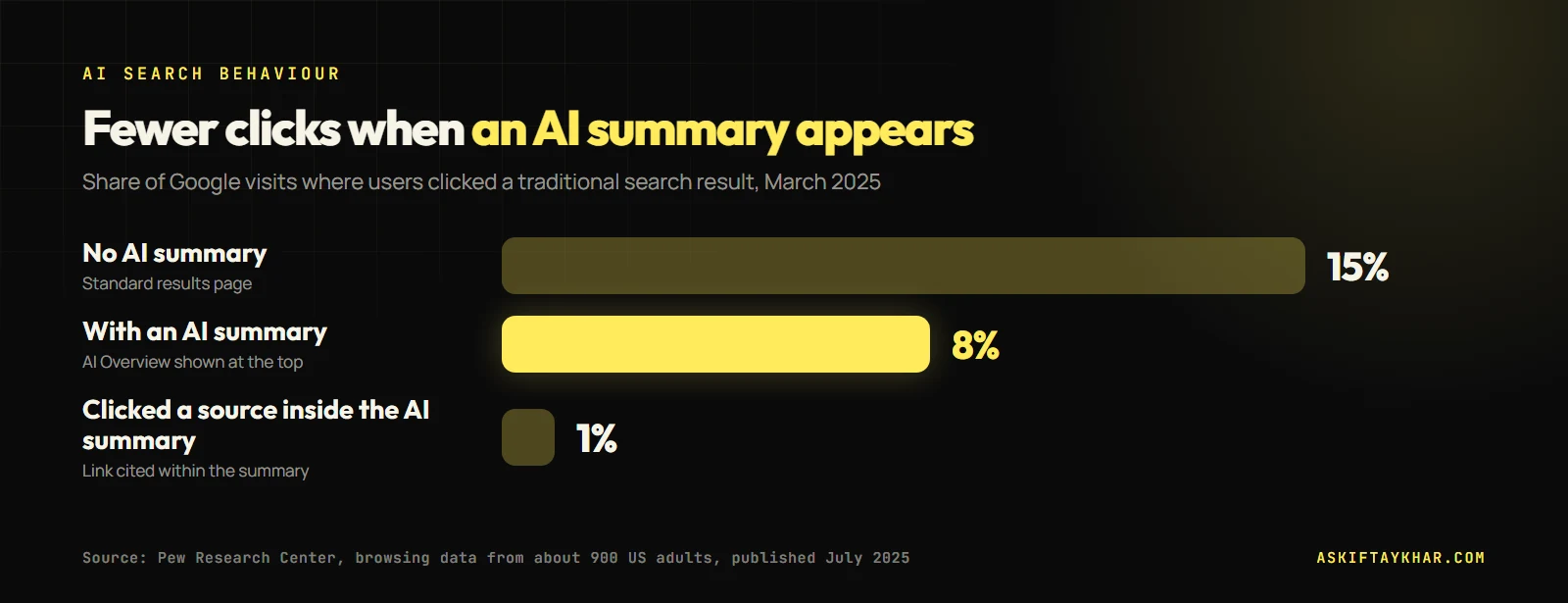
  • Pew found users clicked a traditional result in 8% of Google visits with an AI summary, versus 15% without one.
  • Google said AI Overviews passed 2 billion monthly users in 2025, and OpenAI reported 800 million weekly ChatGPT users.
  • AI systems cite sources they can identify with confidence, so consistent entity information matters.
  • Check that your host is not blocking AI crawlers, even when robots.txt allows them.
Ask ChatGPT or Google for a recommendation in your industry, and look at which businesses get named. They are not always the biggest. They are the ones the AI system can identify clearly, trust, and quote in a sentence. Being cited by ChatGPT and Google’s AI Overviews has quietly become a new kind of visibility, and most small businesses have not started working on it.

I rebuilt this website with that goal in mind, so this guide uses it as a worked example. Everything described here is live on the site you are reading.

Why AI answers now matter for small businesses

The scale is hard to ignore. Google said in July 2025 that AI Overviews had passed 2 billion monthly users. In October 2025, OpenAI said ChatGPT had reached 800 million weekly users.

The behaviour change matters as much as the numbers. Pew Research Center analysed the browsing of about 900 US adults in March 2025 and found that when a Google search showed an AI summary, people clicked a traditional search result in 8% of visits. Without an AI summary, they clicked in 15% of visits. Clicks on the sources cited inside the AI summary itself happened in just 1% of visits.

Chart of Pew Research data: Google users clicked a result in 15% of visits without an AI summary, 8% with one and 1% on sources inside the summary
Pew Research Center, browsing data from about 900 US adults in March 2025.

The takeaway is not that search traffic is dead. It is that being the source an AI names has become part of being found at all.

How to get cited by ChatGPT: make your business a clear entity

AI systems work with entities: people, companies, places, products. Before they will confidently mention you, they need to be sure who you are. Confusion kills citations. On this site, a web search for the owner’s name used to return a different person with a similar name, which is exactly the kind of ambiguity that stops an AI from citing you.

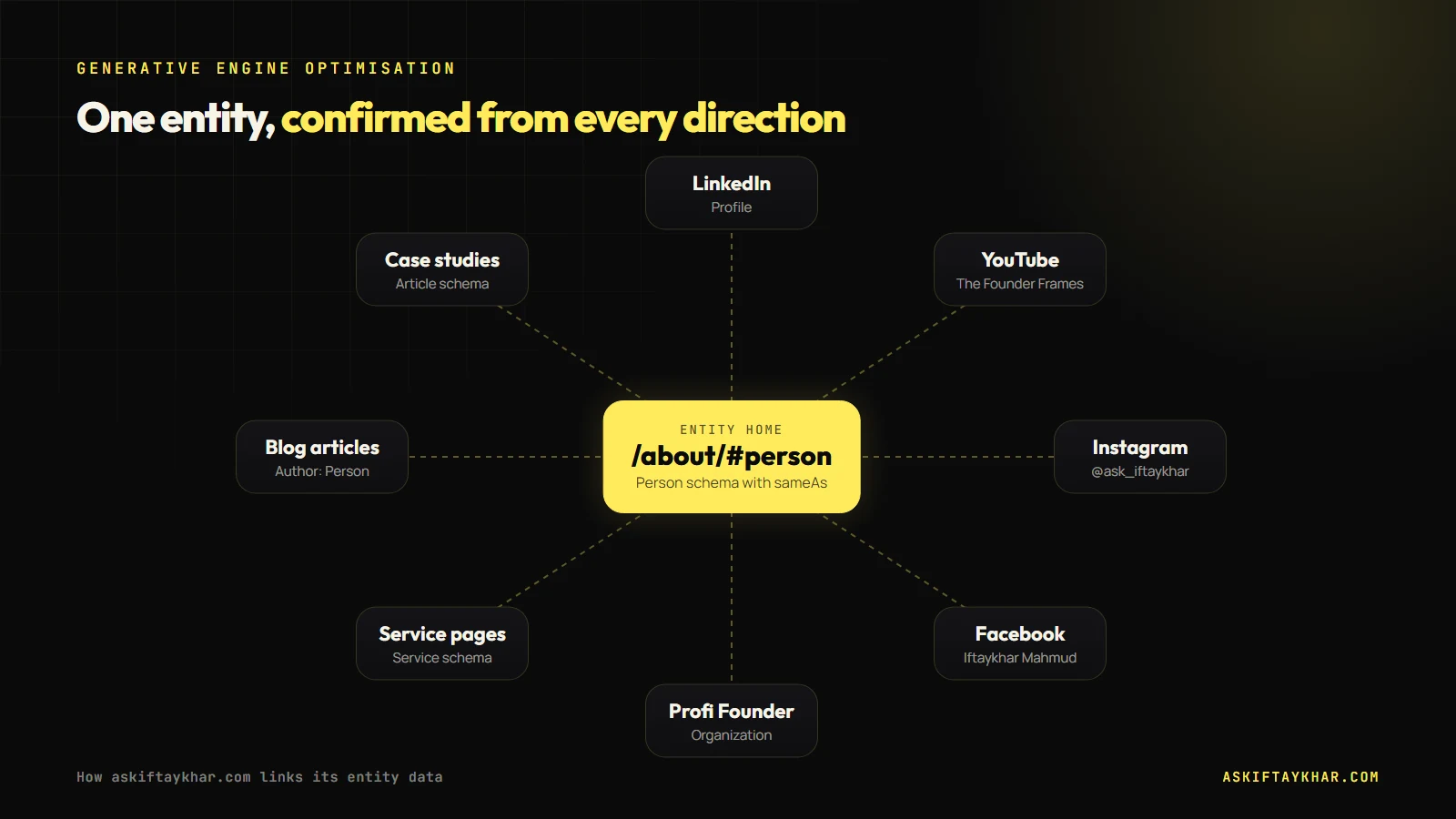
Generative engine optimization diagram of an entity home About page linked by schema to LinkedIn, YouTube, Instagram, Facebook, services and articles
How this website ties one entity together so AI systems can identify it with confidence.

One entity home

Pick one page as the authoritative source about you or your business, usually the About page, and make it complete: who you are, what you do, where you are based, your history, your work and your profiles. On this site, the About page carries the full Person schema with a stable identifier, and every other page refers back to it rather than repeating it.

Consistent profiles, linked both ways

Your LinkedIn, YouTube, Instagram, Facebook and any directory profiles should use the same name, description and location, and link back to your website. On the website, list those same profiles in the schema’s sameAs property and link them visibly on the page. The two directions confirm each other.

Structured data that describes the business

Organization or LocalBusiness schema, Person schema for the founder or author, Service schema for each service, and Article schema with a named author for blog posts. Structured data does not guarantee a citation, but it removes guesswork about what a page is and who stands behind it.

Write pages that are easy to quote

AI answers are built from passages. A page that buries its answer in the fourth paragraph is harder to use than one that answers in the first two sentences.

  • Answer first. Start each service page and article with a direct 40 to 60 word answer to the main question. Every service page on this site opens this way, and every blog post has a “Short answer” box.
  • Use the words people ask with. Headings phrased as real questions, such as “How much does Google Ads cost for a local business?”, match how people prompt AI tools.
  • Be specific. Numbers, places, named sources and clear definitions are easier to cite than general claims.
  • Show who wrote it. A named author with a real bio and profile links, on every article.

A note on FAQ markup: since August 2023, Google only shows FAQ rich results for a small set of well-known government and health websites. I still use FAQ sections and FAQPage schema because they structure answers clearly for people and machines, but not in expectation of the old rich result.

Make sure AI crawlers can actually reach you

This is the step most people skip, and it caught me out. OpenAI runs different crawlers for different jobs: GPTBot for model training, OAI-SearchBot for ChatGPT search, and ChatGPT-User when someone asks ChatGPT to open a page. You control them in robots.txt.

When I audited this site, robots.txt allowed every major AI crawler, yet the hosting layer was returning errors to GPTBot before WordPress even loaded. The search and user-triggered agents were getting through, but it was a clear reminder: robots.txt is not the only gatekeeper. Test what your server actually returns to each crawler.

Two more low-cost steps: submit your sitemap in Google Search Console and Bing Webmaster Tools, and use IndexNow, supported by Bing and other search engines, so new pages are discovered quickly. Some sites also publish an llms.txt file, a proposed convention for summarising a site for language models. No major AI company has confirmed it relies on it, so I treat it as a low-cost extra rather than a strategy.

Earn mentions on other trusted sites

AI systems weigh what others say about you, not just what you say about yourself. Press coverage, podcast appearances, industry directories, client websites that mention your work, and reviews on established platforms all add independent confirmation. For a small business, a few genuine mentions in relevant places beat dozens of low-quality listings.

A client example: a service area machines can read

For Asorin Management Inc., a mobile car key business in the Greater Toronto Area, the website publishes its service area as 20 named suburbs with structured data. When someone asks an AI assistant for a car key replacement service in one of those suburbs, the business has made it easy for machines to confirm that it serves that exact place.

My generative engine optimisation checklist

  1. One entity home page with complete Person or Organization schema.
  2. The same name, description and location on every profile, linked in sameAs.
  3. Service pages and articles that answer the main question in the first 60 words.
  4. Named authors with bios and profile links on every article.
  5. robots.txt and server responses checked for each AI crawler.
  6. Sitemaps submitted and IndexNow enabled.
  7. A plan to earn three to five genuine third-party mentions each quarter.

How long does it take?

Changes to your own site are picked up as quickly as crawlers revisit it, often within days or weeks. Being cited consistently takes longer, because it depends on how AI systems weigh your site against others and on mentions you earn elsewhere. Treat it like SEO: steady work compounds.

If you want this built into your site, entity structure, schema and answer-first pages are part of my website build and design service. The same principles make pages convert better too, as covered in the landing page conversion checklist. You can see how the entity home works on my own About page, and browse the case studies for more client work.

Frequently asked questions

How do I get my business cited by ChatGPT?

Make your business easy to identify and quote: a complete entity page such as your About page, consistent profiles linked with schema, pages that answer questions directly, open access for AI crawlers, and genuine mentions on other trusted websites.

What is generative engine optimisation?

Generative engine optimisation, often shortened to GEO, is the practice of making your content easy for AI systems such as ChatGPT, Perplexity and Google AI Overviews to find, understand and cite in their answers.

Does schema markup help with AI search?

Schema does not guarantee a citation, but it removes ambiguity about who you are, what a page is about and who wrote it. That clarity makes it easier for AI systems and search engines to trust and reference your pages.

Should I block AI crawlers in robots.txt?

If you want to be cited in AI answers, allow the crawlers used for search and user requests, such as OAI-SearchBot and ChatGPT-User. Blocking training crawlers like GPTBot is a separate choice. Whatever you decide, test what your server actually returns, because hosts can block crawlers regardless of robots.txt.

What is llms.txt and do I need it?

llms.txt is a proposed file that summarises a website for language models. No major AI company has confirmed it depends on it, so it is a cheap optional extra, not a replacement for clear pages and structured data.

Keep reading

All articles
Start the conversation

Tell me where
growth is stuck.

Send the brief below or grab a 30-minute discovery slot. You will get a straight answer on whether I can move your numbers, and exactly how.

Send your query

Every field helps me answer properly the first time.